Iran Reviews US Proposal on Strait of Hormuz as Peace Negotiations Remain Deadlocked
Iran Reviews US Proposal on Strait of Hormuz as Peace Negotiations Remain Deadlocked
-
by Unitedforum
Share on:
Iran Reviews US Proposal on Strait of Hormuz as Peace Negotiations Remain Deadlocked
By Dr. Krishna Pandey
President, United Economic Forum
12 October 2026 | International Affairs | United Economic Forum
Tehran signals a response through mediators as disagreements over maritime security and Iran’s nuclear programme complicate efforts to end the conflict
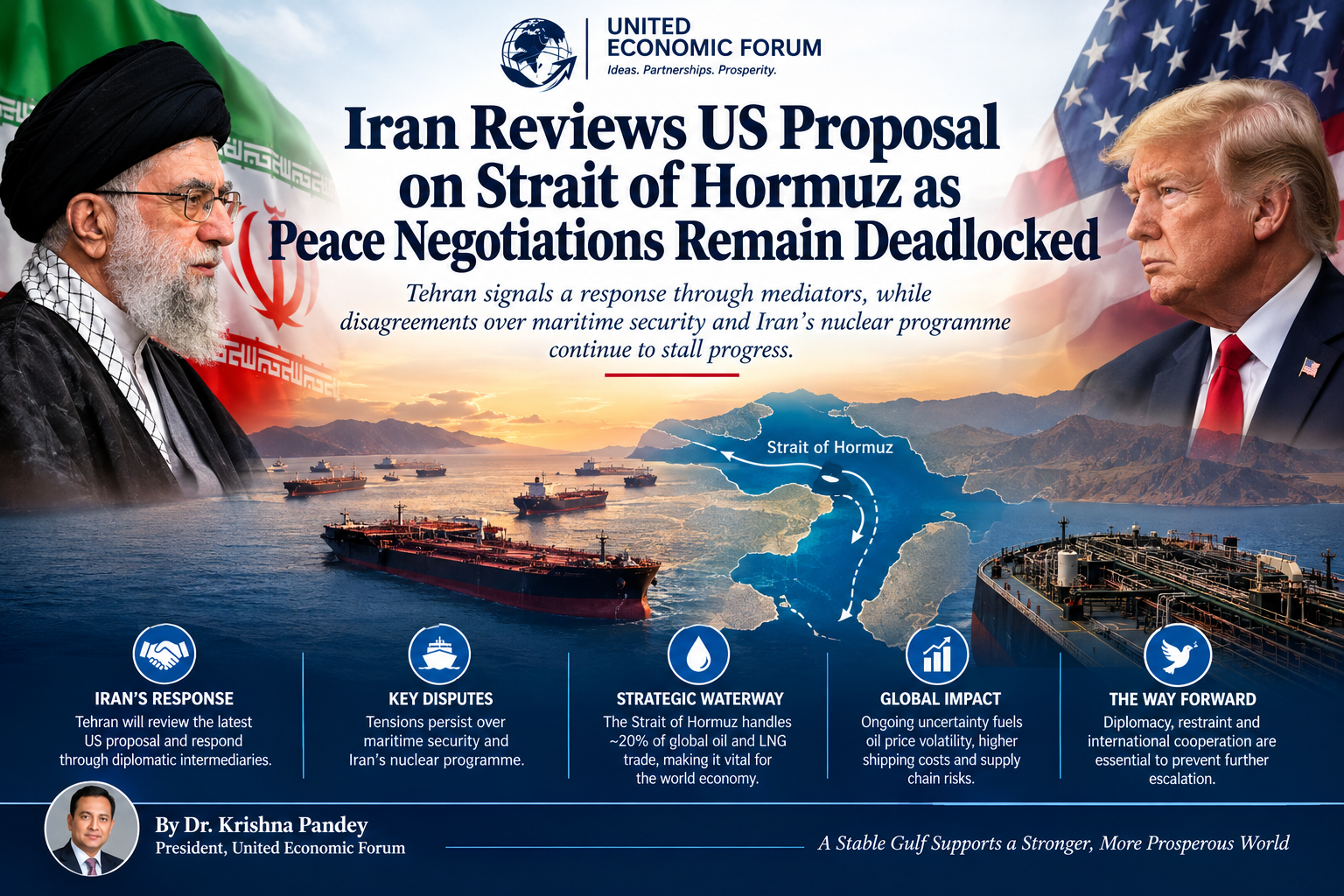
DUBAI / TEHRAN — Iran is reviewing the latest United States response to its proposal for reopening the strategically important Strait of Hormuz and says it will communicate its position through diplomatic intermediaries once the review is complete. The announcement offers a possible opening for renewed dialogue, although significant disagreements continue to obstruct progress toward a broader settlement.
Iranian Foreign Ministry spokesperson Esmaeil Baghaei said on Monday that Tehran was continuing to exchange messages through intermediaries. Qatar and Pakistan have played roles in facilitating communications between the two sides as diplomatic efforts continue to address the conflict.
The announcement follows statements by Iran’s security chief, Mohsen Rezaei, who described Washington’s response to Tehran’s seven conditions as insufficient. Iran has maintained that unresolved issues must be addressed before it agrees to reopen the waterway under the proposed arrangement or move forward with negotiations.
The developments underline the difficulty of securing a diplomatic breakthrough in a conflict that has placed regional security, international shipping and global energy markets under considerable pressure.
A Strategic Waterway at the Centre of Negotiations
The Strait of Hormuz is one of the world’s most important maritime chokepoints, connecting the Persian Gulf with the Gulf of Oman and the wider Indian Ocean. Before the current conflict, approximately one-fifth of global oil and liquefied natural gas trade passed through the waterway.
Any sustained disruption can affect oil shipments, raise transportation and insurance costs, and create uncertainty for energy-importing economies. Countries across Asia, Europe and other regions depend directly or indirectly on the energy supplies and commercial routes passing through the Gulf.
Iran submitted its latest proposal in mid-September, outlining conditions under which maritime passage could be restored. According to reports, Tehran envisaged the possibility of normal shipping resuming within seven days if its conditions were met. However, the subsequent exchange has not yet produced a publicly confirmed comprehensive agreement.
Nuclear Disagreement Remains a Major Obstacle
One of the central differences between Washington and Tehran concerns the sequence and scope of negotiations.
The United States wants Iran’s nuclear programme addressed from the beginning of any negotiations. Tehran, by contrast, has argued that initial discussions should prioritise reopening the Strait of Hormuz and restoring maritime security.
This difference is significant because each side appears to attach different priorities to a potential agreement. Washington is seeking to address wider security concerns, while Tehran is emphasising the immediate consequences of the conflict and the status of the strategic waterway.
Until the two sides find a framework that can accommodate these competing priorities, diplomatic exchanges may continue without producing a durable settlement.
Neither side has publicly confirmed that a final agreement has been reached, and the details of Iran’s seven conditions and Washington’s response remain incompletely disclosed.
Economic Consequences Extend Far Beyond the Middle East
The dispute over the Strait of Hormuz is not simply a regional security issue. It has direct implications for global economic stability.
Higher oil prices can increase production and transportation costs, add to inflationary pressure and complicate monetary policy decisions. Countries that rely heavily on imported fuel may face greater pressure on public finances, trade balances and household purchasing power.
Shipping companies must also consider changing routes, insurance premiums and the risk of vessels operating in an unstable maritime environment. These additional costs can eventually be passed on to businesses and consumers.
For developing economies, particularly those with limited fiscal space and high dependence on imported energy, prolonged disruption could undermine economic growth and increase the cost of essential goods.
The crisis therefore reinforces the need for governments to strengthen energy diversification, improve strategic reserves, expand renewable energy capacity and prepare contingency plans for disruptions to international trade.
Diplomacy Must Take Priority Over Further Escalation
The continuation of indirect communication provides a channel through which the parties may clarify their positions and explore possible compromises. Qatar and Pakistan, along with other countries willing to support negotiations, could help facilitate dialogue and reduce the risk of miscalculation.
A workable arrangement would need to address maritime safety, predictable commercial passage, regional security concerns and the broader disputes that have prevented progress. Any agreement would also require credible implementation mechanisms and clear communication to shipping operators and international markets.
The United Nations and other relevant international institutions can support diplomatic efforts by encouraging restraint, protecting civilian interests and reinforcing the importance of international law and freedom of navigation.
The immediate priority should be to prevent further escalation and establish reliable arrangements that protect commercial vessels and seafarers. Broader questions concerning Iran’s nuclear programme and regional security will require sustained negotiations rather than short-term measures alone.
The Way Forward: Stability, Cooperation and Shared Responsibility
The latest developments demonstrate that the reopening of the Strait of Hormuz is closely connected to the wider challenge of achieving peace between Iran, the United States and their regional partners.
For the international community, the stakes are substantial. Continued confrontation could deepen energy-market uncertainty, disrupt global supply chains and intensify geopolitical divisions. A negotiated settlement, by contrast, could help restore confidence in maritime commerce and create space for addressing the underlying causes of the conflict.
Governments should therefore prioritise diplomatic engagement, transparent communication and practical measures to protect shipping. Energy-importing nations should also work together to reduce vulnerability to supply shocks, while international organisations and regional partners should support a credible path toward de-escalation.
The situation remains uncertain, and Iran’s forthcoming response will be an important development to watch. Yet the broader lesson is clear: strategic waterways cannot be separated from the political relationships that determine whether they remain safe and accessible.
Peaceful negotiation, respect for international law and sustained international cooperation offer the strongest foundation for protecting regional stability and the global economy.
About the Author
Dr. Krishna Pandey is President of the United Economic Forum and writes on international affairs, geopolitics, economic cooperation and sustainable development.
Editorial note: This article reflects publicly reported developments available on 12 October 2026. The diplomatic process remains fluid, and positions attributed to the parties should not be interpreted as confirmation of an agreement. The analysis and recommendations are presented for public discussion.
Related post






Latest world's most important and pressing issues
more
Reports
Medical Tourism: Global Trend or Local Marvel? Exploring the Rise and Impact
Sep, 05, 2023
Unitedforum

Reports
Redefining Work and Wanderlust: The Era of Digital Nomads Revolutionizing Remote Work Culture
Sep, 05, 2023
Unitedforum
Upcoming events
Past events

EVENT
4th World Congress on Public Health and Nutrition
Welcome to the 4th World Congress on Public Health and Nutrition (Public Health 2019). It is a one-of-a-kind event showc...

EVENT
EPCC PAVILION- IMEX AMERICA
Show opening times Attendees: Doors are open to attendees from 9:00am to 6:00pm Tuesday October 17 and Wednesday Octobe...

EVENT
2nd World Congress on Patient Safety & Quality Healthcare
Conference Series extends its welcome to 2nd World Congress on Patient Safety & Quality Healthcare in Dublin, Ireland. W...



EVENT
EPCC- EUROPEAN MEDICAL TOURISM
Medical tourism, still little known in some countries (for example in Italy) is growing exponentially. In brief, it is...


EVENT
NOW- NATURAL ORGANIC WELNESS
Conference: September 21–22, 2023 Trade Show: September 23–24,2023

EVENT
Business Continuity Management Training Program
EPCC Global has been conducting five days training program on Business Continuity Management for Young Entrepreneurs.

EVENT
19th International Conference on Healthcare, Nutrition & Fitness Expo
Welcome to the 4th World Congress on Public Health and Nutrition (Public Health 2019). It is a one-of-a-kind event showc...