Nepal Rescuers Reach Flood-Hit Villages as Five People Remain Missing: A Wake-Up Call for Disaster Preparedness and Climate Resilience
Nepal Rescuers Reach Flood-Hit Villages as Five People Remain Missing: A Wake-Up Call for Disaster Preparedness and Climate Resilience
-
by Unitedforum
Share on:
Nepal Rescuers Reach Flood-Hit Villages as Five People Remain Missing: A Wake-Up Call for Disaster Preparedness and Climate Resilience
By Dr. Krishna Pandey
President, United Economic Forum
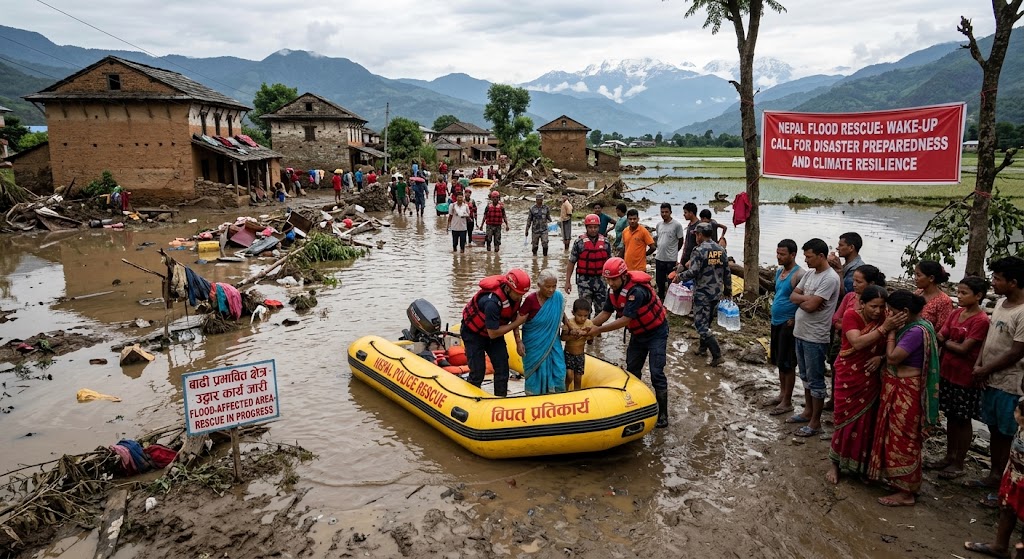
KATHMANDU, 12 October 2026 — Rescue teams from the Nepal Army have reached flood-affected villages along the Budhi Gandaki River in north-central Nepal, delivering emergency supplies and evacuating residents and stranded tourists after a devastating flash flood swept through the mountainous region on Sunday, 11 October. At least five residents remain missing, while damaged bridges, homes, farmland, and hydropower construction sites have intensified concerns about the safety of mountain communities and Nepal’s critical infrastructure. <Cite refs={["turn503613news11","turn503613search8"]}/>
The disaster occurred in Gorkha district after a landslide near Chumchure blocked the river, triggering a sudden surge of floodwater downstream. Authorities reported that an early warning helped many residents move to higher ground before the flood struck, preventing further loss of life.
According to reports published on 12 October, rescue teams had evacuated hundreds of people, including foreign visitors, while helicopters and ground personnel continued delivering food, tents, medicines, and other essential supplies to isolated settlements. Damaged roads and bridges, together with difficult weather conditions, complicated relief operations. <Cite refs={["turn503613news12","turn503613news11"]}/>
The disaster has renewed urgent questions about Nepal’s preparedness for sudden mountain hazards, the vulnerability of its hydropower infrastructure, and the need for stronger coordination between local communities, government agencies, and regional partners.
A mountain disaster with far-reaching consequences
The Budhi Gandaki River corridor is an important part of Nepal’s mountain environment and economic landscape. Its communities depend on agriculture, tourism, transport infrastructure, and developing energy projects for their livelihoods.
The latest flooding damaged or destroyed five bridges, affected dozens of houses and farms, and struck construction sites associated with three hydropower projects, according to the Associated Press.
The loss of bridges and road connections creates challenges beyond the immediate emergency. It can restrict access to health services, disrupt the delivery of essential goods, interrupt tourism activities, and delay infrastructure development.
For communities in remote Himalayan valleys, a damaged bridge can mean the temporary loss of a vital connection to markets, education, healthcare, and emergency assistance.
The incident demonstrates that disaster management in mountainous countries must account for the interconnected nature of infrastructure. Roads, bridges, telecommunications, electricity networks, and community warning systems cannot be planned independently when a single event can disrupt several services simultaneously.
Early warning saved lives, but preparedness must improve
One important lesson from the Budhi Gandaki disaster is the value of timely warnings.
Authorities indicated that advance alerts enabled many people to move away from the river before the flood reached vulnerable settlements. This underlines the importance of reliable monitoring, clear communication, and rapid community response.
However, an effective warning system must do more than detect danger. It must ensure that information reaches residents, trekkers, hydropower workers, local administrators, and emergency responders in time for them to take appropriate action.
Nepal should continue strengthening its early-warning capabilities through improved rainfall and river monitoring, landslide surveillance, emergency communication networks, and community evacuation planning.
Special attention is required in remote areas where mobile connectivity is limited, transport routes are fragile, and access for rescue teams may be restricted by weather or terrain.
Local governments should regularly conduct emergency drills and identify safe evacuation routes, temporary shelters, and alternative access arrangements. Hydropower developers and tourism operators should also maintain site-specific emergency plans and communication protocols.
The objective must be to turn warnings into timely action and reduce the time required to reach vulnerable communities.
Hydropower security and economic resilience
The damage to hydropower construction sites highlights a broader concern for Nepal’s economic development.
Hydropower is one of the country’s most important potential sources of domestic electricity, export earnings, employment, and investment. Yet projects located in steep river valleys may face exposure to floods, landslides, sediment movement, and other natural hazards.
Damage during construction can delay completion, increase costs, interrupt financing arrangements, and affect expected revenue. Access roads and transmission infrastructure may also be damaged even when generating equipment remains intact.
Nepal should therefore strengthen the integration of disaster-risk assessments into hydropower planning and investment decisions. Project assessments should examine river behaviour, slope stability, upstream hazards, flood exposure, and the reliability of associated transport and transmission systems.
These measures are essential to protect existing investments and ensure that future energy development remains economically viable.
Climate change adds another layer of complexity. Although the specific cause of the Budhi Gandaki event requires detailed scientific investigation, the disaster highlights the need to assess the combined effects of changing climate conditions, geological instability, and vulnerable infrastructure across the Himalayan region.
Climate change and Himalayan disaster diplomacy
Nepal’s mountainous geography exposes it to several interconnected hazards, including intense rainfall, landslides, glacial lake outburst floods, and sudden river surges. These events can affect communities and infrastructure across national boundaries.
The latest Budhi Gandaki flood also follows the catastrophic August 2026 disaster in the Nepal–China border region, underscoring the scale of the challenge facing disaster-management institutions. The International Centre for Integrated Mountain Development has emphasised the importance of understanding the different processes capable of generating destructive floods in Himalayan river systems.
Nepal should use this experience to strengthen regional cooperation with China, India, Bangladesh, and international scientific organisations.
Priority areas include:
Sharing relevant hydrological and meteorological information.
Improving monitoring of unstable slopes, glaciers, and potentially dangerous glacial lakes.
Developing faster cross-border disaster-warning mechanisms.
Supporting scientific research into Himalayan flood hazards.
Mobilising climate finance for resilient infrastructure and disaster preparedness.
Strengthening emergency coordination in remote mountain regions.
Regional cooperation should be based on scientific evidence, transparent communication, and the shared objective of protecting human lives.
Himalayan diplomacy must become more practical and results-oriented, ensuring that cooperation between neighbouring countries contributes directly to community safety and economic resilience.
The role of government, businesses, and communities
Disaster resilience requires coordinated action by public institutions, the private sector, and local communities.
The government should prioritise rapid relief, transparent assessments of damage, the restoration of essential services, and support for affected households. Reconstruction should follow improved safety standards rather than simply reproducing vulnerable infrastructure.
Businesses and investors should review emergency plans, protect workers at construction sites, and ensure that projects have appropriate insurance and disaster-response arrangements.
Local communities should be included in risk mapping, evacuation planning, and decisions about reconstruction. Their knowledge of river behaviour, seasonal hazards, and local access routes can contribute significantly to effective preparedness.
International development partners can assist through technical expertise, emergency funding, resilient infrastructure programmes, and improved forecasting technologies.
For the United Economic Forum, this is an opportunity to promote a development approach that recognises disaster resilience as a fundamental component of economic security.
A call for resilient and sustainable development
Dr. Krishna Pandey, President of the United Economic Forum, emphasises the importance of placing human safety, economic resilience, and sustainable infrastructure at the centre of Nepal’s development priorities.
The latest disaster demonstrates that economic progress cannot be measured solely by the number of roads, bridges, and hydropower projects constructed. It must also be measured by their ability to withstand hazards, protect communities, and continue delivering essential services during emergencies.
Nepal needs stronger institutions, better early-warning systems, more resilient infrastructure, and long-term investment in disaster preparedness. These measures can reduce future losses while strengthening investor confidence and protecting livelihoods.
The country should also ensure that reconstruction funds are allocated transparently and that the needs of vulnerable households receive priority.
Conclusion: Protecting lives must come before rebuilding assets
The Budhi Gandaki flood is a sobering reminder of the risks faced by Nepal’s mountain communities. With five residents still reported missing as of 12 October, rescue and relief operations remain the immediate priority. The restoration of roads, bridges, electricity, and livelihoods will require sustained coordination and resources.
The disaster also offers a critical lesson for Nepal’s long-term development strategy: resilience must be built before the next emergency, not improvised after it.
Through stronger local preparedness, scientific cooperation, climate-resilient infrastructure, and effective regional diplomacy, Nepal can reduce its vulnerability to future disasters and protect the people and investments essential to its economic future.
A resilient Nepal is not simply a country that recovers after disasters. It is a country that prepares effectively, protects its most vulnerable communities, and builds infrastructure capable of supporting sustainable prosperity for generations to come.
Published for the United Economic Forum.
About the author: Dr. Krishna Pandey is the President of the United Economic Forum. His policy interests include economic development, climate resilience, regional cooperation, infrastructure investment, and sustainable prosperity.
Sources and further reading
Associated Press, 12 October 2026 — Nepal rescuers reach flood-hit villages as at least five people are reported missing.
Reuters, 12 October 2026 — More than 100 foreign trekkers stranded in flood-hit region of Nepal.
Radio Nepal, 11 October 2026 — Budhi Gandaki floods: five go missing, 437 security personnel mobilized for search and rescue.
Euronews, 11 October 2026 — Nepal flash floods sweep away houses, five people missing.
Editorial note: This article is based on reporting available on 12 October 2026. The missing-person count and damage assessments may change as authorities continue search and recovery operations. The article is a prepared publication draft; any statements presented as Dr. Pandey’s personal views should be approved by him before publication.
Related post






Latest world's most important and pressing issues
more
Reports
Medical Tourism: Global Trend or Local Marvel? Exploring the Rise and Impact
Sep, 05, 2023
Unitedforum

Reports
Redefining Work and Wanderlust: The Era of Digital Nomads Revolutionizing Remote Work Culture
Sep, 05, 2023
Unitedforum
Upcoming events
Past events

EVENT
4th World Congress on Public Health and Nutrition
Welcome to the 4th World Congress on Public Health and Nutrition (Public Health 2019). It is a one-of-a-kind event showc...

EVENT
EPCC PAVILION- IMEX AMERICA
Show opening times Attendees: Doors are open to attendees from 9:00am to 6:00pm Tuesday October 17 and Wednesday Octobe...

EVENT
2nd World Congress on Patient Safety & Quality Healthcare
Conference Series extends its welcome to 2nd World Congress on Patient Safety & Quality Healthcare in Dublin, Ireland. W...



EVENT
EPCC- EUROPEAN MEDICAL TOURISM
Medical tourism, still little known in some countries (for example in Italy) is growing exponentially. In brief, it is...


EVENT
NOW- NATURAL ORGANIC WELNESS
Conference: September 21–22, 2023 Trade Show: September 23–24,2023

EVENT
Business Continuity Management Training Program
EPCC Global has been conducting five days training program on Business Continuity Management for Young Entrepreneurs.

EVENT
19th International Conference on Healthcare, Nutrition & Fitness Expo
Welcome to the 4th World Congress on Public Health and Nutrition (Public Health 2019). It is a one-of-a-kind event showc...