Nepal at the Crossroads of Geopolitics: Turning Strategic Location into Economic Prosperity
Nepal at the Crossroads of Geopolitics: Turning Strategic Location into Economic Prosperity
-
by Unitedforum
Share on:
Nepal at the Crossroads of Geopolitics: Turning Strategic Location into Economic Prosperity
Geography as Both an Opportunity and a Challenge:
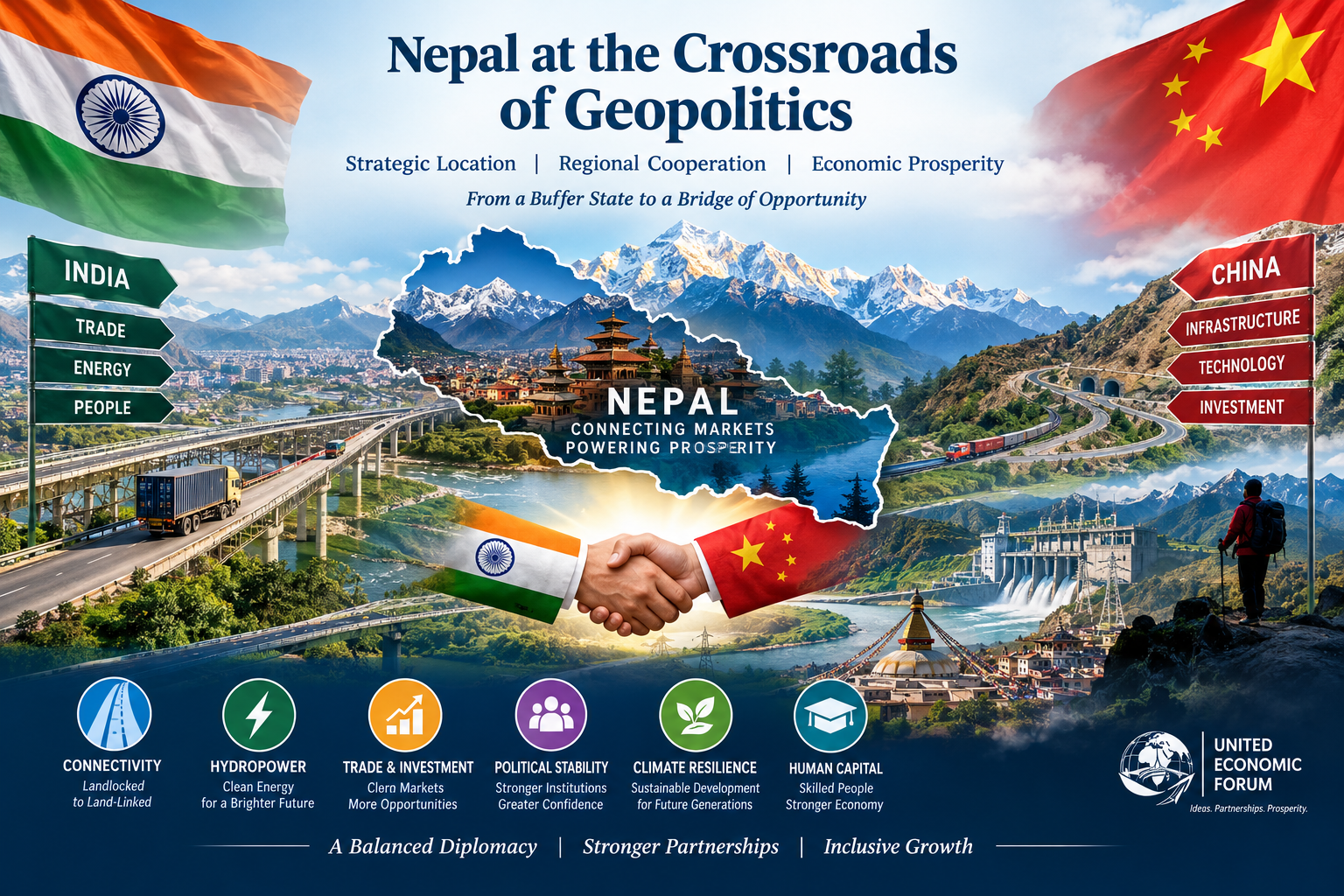
Nepal occupies a unique position in the changing geopolitical landscape of South Asia. Situated between India and China, two major Asian powers with growing economic and strategic influence, Nepal’s geography presents both significant opportunities and complex challenges. Its location, natural resources, cultural heritage, and potential for regional connectivity give the country strategic importance far beyond its size.
However, geographical importance alone does not guarantee economic prosperity. The real challenge for Nepal is to transform its strategic position into tangible benefits for its people through effective diplomacy, stable governance, sustainable investment, and a clear long-term economic vision.
In an increasingly multipolar world, Nepal must move beyond the traditional perception of being a small country caught between competing powers. Instead, it should develop a confident foreign policy that positions the nation as a bridge for trade, energy cooperation, tourism, technology, and investment between South Asia and the wider Asian economy.
For Nepal, geopolitics should not simply be a matter of managing relations with powerful neighbours. It should be a practical instrument for national development.
1. Nepal Between India and China: The Need for Strategic Balance
India and China are central to Nepal’s foreign policy, but their importance to Nepal is expressed in different ways.
India shares an open border with Nepal and maintains deep historical, cultural, social, and economic connections with the country. India is a major destination for Nepali trade and employment, an important source of essential goods, and a critical partner in energy cooperation, infrastructure development, and access to international markets.
China, meanwhile, offers opportunities for infrastructure development, tourism, technology, trade diversification, and improved connectivity across the Himalayan region. Nepal’s engagement with China also reflects its aspiration to reduce geographical constraints and expand its economic options.
The challenge is not to choose one neighbour over the other. Such a choice would unnecessarily restrict Nepal’s strategic autonomy and economic opportunities.
Instead, Nepal needs a policy of balanced engagement based on national interest, mutual respect, sovereign equality, and measurable economic benefits. Cooperation with India should not prevent Nepal from developing constructive relations with China, just as cooperation with China should not undermine Nepal’s historically important relationship with India.
This approach requires consistency, transparency, and diplomatic maturity. Every major agreement should be assessed according to its contribution to Nepal’s economic development, national security, fiscal sustainability, and long-term independence.
Nepal’s foreign policy should be guided neither by external pressure nor by domestic political rivalries. It should be guided by a clear understanding of what serves the interests of the Nepali people.
2. From Geopolitical Competition to Geo-economic Cooperation
The emerging competition among major powers is often discussed in terms of strategic influence. Yet for Nepal, the most important question is economic: how can international partnerships create productive assets, employment, and sustainable growth?
China’s Belt and Road Initiative (BRI), India’s regional connectivity programmes, and the United States’ development partnership through the Millennium Challenge Corporation (MCC) represent different forms of international engagement. Each has its own objectives, financing structures, conditions, and strategic context.
Nepal should evaluate these initiatives through transparent economic analysis rather than political assumptions.
The central questions should be straightforward:
Will the proposed project reduce transportation and logistics costs?
Will it create employment and strengthen domestic industries?
Is its financing affordable and fiscally sustainable?
Will it improve Nepal’s access to regional and international markets?
Does it provide technology transfer and opportunities for Nepali enterprises?
Are procurement, environmental safeguards, and project implementation transparent?
The Nepal–China Framework for Belt and Road Cooperation itself recognises the importance of feasibility analysis, financial arrangements, and value for money. These principles should guide implementation and evaluation.
Similarly, development cooperation with India, the United States, multilateral development banks, the European Union, Japan, and other partners should be judged by its contribution to Nepal’s development priorities.
The objective is not to reject foreign assistance or investment. It is to ensure that international partnerships strengthen Nepal’s productive capacity instead of creating excessive financial obligations or strategic dependencies.
3. Connectivity: Transforming Nepal from Landlocked to Land-Linked
Nepal’s landlocked geography is one of its most persistent economic constraints. Dependence on transit routes through neighbouring countries exposes businesses to transportation costs, border delays, supply-chain disruptions, and external policy changes.
Yet this constraint is not insurmountable. Nepal can gradually position itself as a land-linked economy by improving road networks, modernising customs systems, strengthening border infrastructure, developing dry ports, and expanding reliable connections with Indian and Chinese markets.
Connectivity with India remains especially important because of the established trade networks and practical access they provide. At the same time, carefully selected cross-border connections with China could diversify Nepal’s trade options and strengthen its access to northern markets.
Such projects must be evaluated realistically. Himalayan terrain, high construction and maintenance costs, geological risks, and difficult weather conditions can make cross-border infrastructure expensive. A project should therefore proceed on the basis of commercial viability, environmental sustainability, and credible demand—not merely its geopolitical symbolism.
Nepal should also deepen practical regional cooperation with Bangladesh through available transit arrangements and electricity trade opportunities, working with India and other relevant partners where necessary.
A more connected Nepal could facilitate regional commerce, attract investment in logistics and manufacturing, and provide new opportunities for businesses seeking access to South Asian markets.
The long-term ambition should be to make Nepal a reliable economic corridor, not simply a transit route on a map.
4. Hydropower: Nepal’s Strategic Economic Asset
Among Nepal’s greatest economic opportunities is its hydropower potential. The country’s rivers and mountainous geography offer substantial possibilities for electricity generation, although the development of this potential requires careful environmental, financial, and technical planning.
Hydropower can contribute to Nepal’s economic transformation in three major ways.
First, electricity exports can generate foreign exchange and strengthen regional economic interdependence. Cross-border electricity trade with India already demonstrates the practical value of energy cooperation, while future opportunities with Bangladesh depend on suitable transmission arrangements and regional agreements.
Second, reliable and affordable electricity can support domestic industrialisation. Nepal should seek to develop industries that use electricity productively, including information technology services, tourism infrastructure, selected manufacturing activities, and other commercially viable sectors.
Third, hydropower investment can stimulate employment, infrastructure development, and local economic activity when projects are designed with meaningful community participation and environmental safeguards.
However, energy diplomacy must be supported by credible commercial arrangements. Nepal needs predictable power-purchase agreements, adequate transmission capacity, diversified buyers, effective regulation, and fair arrangements for sharing local benefits.
The strategic value of hydropower lies not only in the volume of electricity generated, but also in the domestic economic value created from it.
5. Domestic Political Stability and Institutional Credibility
No foreign policy can be more effective than the institutions responsible for implementing it.
Frequent policy changes, prolonged political disputes, administrative delays, corruption risks, and inconsistent project execution can weaken Nepal’s negotiating position. International partners and investors need confidence that agreements will be implemented transparently and that economic policies will remain reasonably predictable across changes of government.
Political stability does not require the absence of disagreement. It requires institutions capable of managing disagreement without compromising national priorities.
Nepal should strengthen parliamentary scrutiny of major international agreements, professionalise its diplomatic service, improve public access to project information, and establish transparent mechanisms for evaluating foreign-funded projects.
Long-term national priorities should also enjoy broad political consensus. Energy development, export diversification, climate resilience, education, digital infrastructure, and regional connectivity should not be repeatedly redesigned according to short-term political calculations.
A credible state negotiates from a position of preparation. It understands the costs and benefits of agreements, consults affected communities, and maintains the technical capacity to monitor implementation.
For Nepal, stronger domestic governance is not merely an administrative objective. It is a strategic asset in international relations.
6. Economic Diplomacy and the Role of the Private Sector
Geopolitical discussions often focus on governments, diplomats, and security concerns. Yet businesses, entrepreneurs, investors, and economic institutions are equally important to Nepal’s international engagement.
The private sector can help translate diplomatic relationships into trade, employment, technology partnerships, and investment opportunities. For this to happen, economic diplomacy must become more systematic and results-oriented.
Nepal should strengthen commercial diplomacy through its embassies and trade missions, improve market intelligence for domestic enterprises, facilitate business-to-business partnerships, and support participation in international trade fairs and investment forums.
Priority sectors could include hydropower, tourism, information technology, agricultural processing, medicinal and high-value agricultural products, and selected manufacturing industries.
The country should also improve the conditions that influence investment decisions: policy predictability, access to finance, efficient customs procedures, contract enforcement, digital public services, and transparent regulation.
Investment promotion must be matched by investment facilitation. Announcing opportunities is not enough if businesses subsequently encounter lengthy approvals, unclear rules, or inadequate infrastructure.
In this context, the United Economic Forum can contribute by encouraging dialogue among policymakers, investors, entrepreneurs, academics, and development partners. It can promote evidence-based debate, facilitate partnerships, and help identify practical reforms that connect Nepal’s foreign policy objectives with domestic economic priorities.
The central objective should be to make international relations work for productive enterprise and inclusive growth.
7. Climate Change, Water Security, and Himalayan Diplomacy
Nepal’s geopolitical future is inseparable from its environmental future.
The Himalayas are central to regional water systems, biodiversity, tourism, and the livelihoods of millions of people. Glacial change, floods, landslides, changing rainfall patterns, and other climate-related risks threaten infrastructure, agriculture, settlements, and hydropower investments.
These challenges cross national borders and cannot be addressed by Nepal alone.
Nepal should therefore strengthen climate diplomacy with India, China, Bangladesh, and international partners. Priorities should include climate finance, early-warning systems, disaster preparedness, scientific cooperation, sustainable mountain tourism, and the sharing of relevant hydrological and climate information.
Water cooperation should be based on scientific evidence, mutual benefit, transparent agreements, and equitable consideration of affected communities.
Nepal can also use international climate forums to highlight the disproportionate risks faced by mountain countries and advocate for accessible financing for adaptation and resilience.
Climate diplomacy should not remain confined to international conferences. It should help mobilise resources for safer infrastructure, resilient agriculture, better disaster management, and sustainable livelihoods at home.
8. A Practical Roadmap for Nepal’s Geopolitical Future
To turn strategic opportunities into lasting economic benefits, Nepal should pursue a coherent set of policy priorities.
First, institutionalise balanced diplomacy. Maintain constructive relations with India and China while deepening engagement with the United States, the European Union, Japan, multilateral institutions, and other partners. Decisions should reflect Nepal’s national interests rather than a presumed obligation to align with any external power.
Second, establish rigorous project appraisal. Major infrastructure and development agreements should undergo transparent assessments of financial sustainability, economic returns, environmental impact, and strategic implications. Public accountability should be strengthened throughout implementation.
Third, prioritise export-oriented growth. Improve the competitiveness of domestic businesses, expand electricity exports, support digital services, and develop tourism and agricultural value chains that generate employment and foreign exchange.
Fourth, strengthen regional connectivity. Invest in commercially viable transport corridors, modern customs systems, border facilities, electricity transmission, and practical trade arrangements with neighbouring countries.
Fifth, improve governance and policy continuity. Build professional institutions, reduce administrative uncertainty, strengthen regulatory credibility, and protect major development priorities from unnecessary political disruption.
Sixth, broaden public and private participation. Consult businesses, local communities, independent experts, and civil society before committing to major projects. Public understanding and institutional transparency can strengthen the legitimacy of international agreements.
Seventh, invest in human capital. Geopolitical advantages become economically meaningful only when supported by skilled workers, capable entrepreneurs, modern technology, and effective public institutions. Education, vocational training, research, and digital capabilities should therefore be treated as strategic investments.
Conclusion: From a Buffer State to a Bridge of Opportunity
Nepal stands at an important crossroads in the evolving Asian order. Its location between India and China, its relationships with major global powers, and its potential in hydropower, tourism, and regional connectivity offer significant opportunities. But these opportunities will not automatically translate into prosperity.
The decisive factor will be Nepal’s ability to combine diplomatic balance with economic discipline, institutional credibility, and a clear development strategy.
Nepal should neither underestimate the importance of its neighbours nor assume that competition among major powers will automatically benefit the country. Instead, it must negotiate carefully, select projects on their merits, diversify its economic relationships, and strengthen the domestic institutions that turn international cooperation into tangible results.
The ultimate measure of successful geopolitics is not how frequently Nepal appears in strategic calculations, but whether its citizens enjoy better employment opportunities, stronger infrastructure, greater economic security, and improved living standards.
For the United Economic Forum and the wider economic community, the message is clear: Nepal’s future should not be defined by the rivalry of larger powers. It should be shaped by Nepal’s own capacity to build partnerships, generate prosperity, and pursue development with confidence.
The strategic ambition should be simple: transform Nepal’s geography from a constraint into an asset, its diplomacy into an engine of economic growth, and its international relationships into lasting opportunities for the Nepali people.
References and further reading
Ministry of Foreign Affairs, Government of Nepal. Framework for Belt and Road Cooperation between Nepal and China.
The Kathmandu Post. Geoeconomics: The New Geopolitics in Nepal, 1 January 2025.
International Politics, Springer Nature. Foreign Policy Strategies of Nepal Between China and India: Bandwagon or Hedging.
ISPI. Himalayan Geopolitics: Nepal Between India and China, 27 January 2026.
The Kathmandu Post. The Strategic Interests of Major Powers in Nepal, 20 June 2026.
Editorial note: This article presents an independent policy perspective. The references provide background for further verification and do not imply endorsement by the cited organisations. Please confirm any institutional publication requirements, author attribution, and current project details before publication.
Related post






Latest world's most important and pressing issues
more
Reports
Medical Tourism: Global Trend or Local Marvel? Exploring the Rise and Impact
Sep, 05, 2023
Unitedforum

Reports
Redefining Work and Wanderlust: The Era of Digital Nomads Revolutionizing Remote Work Culture
Sep, 05, 2023
Unitedforum
Upcoming events
Past events

EVENT
4th World Congress on Public Health and Nutrition
Welcome to the 4th World Congress on Public Health and Nutrition (Public Health 2019). It is a one-of-a-kind event showc...

EVENT
EPCC PAVILION- IMEX AMERICA
Show opening times Attendees: Doors are open to attendees from 9:00am to 6:00pm Tuesday October 17 and Wednesday Octobe...

EVENT
2nd World Congress on Patient Safety & Quality Healthcare
Conference Series extends its welcome to 2nd World Congress on Patient Safety & Quality Healthcare in Dublin, Ireland. W...



EVENT
EPCC- EUROPEAN MEDICAL TOURISM
Medical tourism, still little known in some countries (for example in Italy) is growing exponentially. In brief, it is...


EVENT
NOW- NATURAL ORGANIC WELNESS
Conference: September 21–22, 2023 Trade Show: September 23–24,2023

EVENT
Business Continuity Management Training Program
EPCC Global has been conducting five days training program on Business Continuity Management for Young Entrepreneurs.

EVENT
19th International Conference on Healthcare, Nutrition & Fitness Expo
Welcome to the 4th World Congress on Public Health and Nutrition (Public Health 2019). It is a one-of-a-kind event showc...