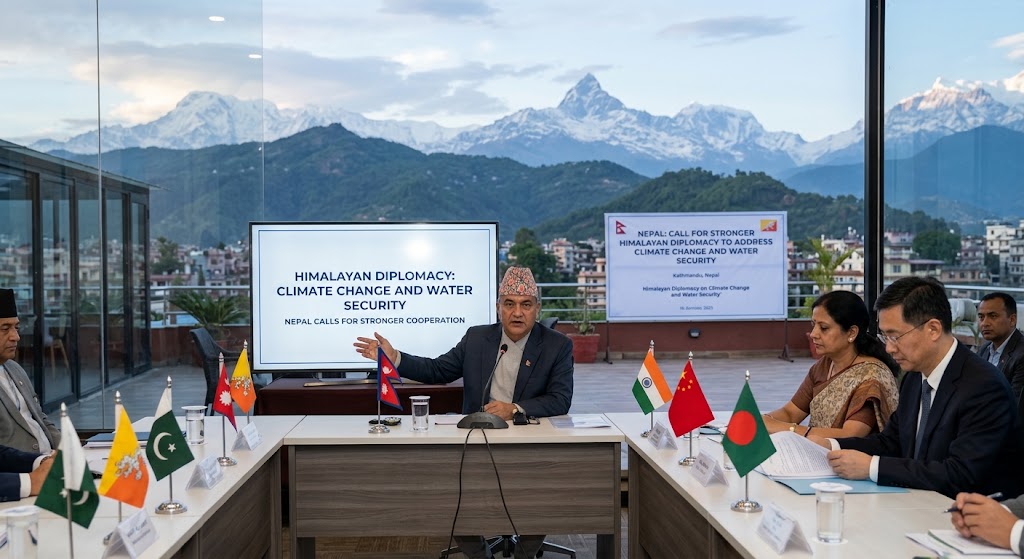
Nepal Calls for Stronger Himalayan Diplomacy to Address Climate Change and Water Security
“The future of Nepal’s water security cannot be separated from the future of the Himalayas. Protecting our mountains, rivers, and communities requires collective responsibility, scientific cooperation, and a shared regional vision,” is the central message of this policy perspective.
-
by Unitedforum
Share on:
Nepal Calls for Stronger Himalayan Diplomacy to Address Climate Change and Water Security
KATHMANDU, Nepal — Nepal’s growing exposure to climate-related disasters has underscored the urgent need for stronger regional cooperation, effective water governance, and a new approach to Himalayan diplomacy, with climate change emerging as a critical issue for economic security and sustainable development across South Asia.
As a Himalayan nation situated between India and China, Nepal occupies a strategic position in regional water systems, biodiversity conservation, hydropower development, and climate resilience. However, rising temperatures, changing precipitation patterns, glacial retreat, landslides, floods, and other environmental hazards are placing increasing pressure on communities, infrastructure, agriculture, and energy production.
Dr. Krishna Pandey, President of the United Economic Forum, emphasizes that climate change must be addressed not only as an environmental concern but also as a geopolitical, economic, and humanitarian priority.
“The future of Nepal’s water security cannot be separated from the future of the Himalayas. Protecting our mountains, rivers, and communities requires collective responsibility, scientific cooperation, and a shared regional vision,” is the central message of this policy perspective.
Himalayan climate risks demand urgent action
The Hindu Kush Himalaya region plays a vital role in sustaining ecosystems, livelihoods, and water resources across Asia. Changes in glaciers, snow cover, rainfall, and river flows can have consequences extending far beyond national boundaries.
Nepal’s recent experience with severe flooding and glacier-related hazards has further highlighted the importance of disaster preparedness, reliable early-warning systems, and timely information sharing. In August 2026, a devastating flood in the Bhote Koshi region prompted Nepal to renew calls for improved cross-border cooperation on glacier monitoring and disaster alerts. International experts have also highlighted the challenges of financing recovery and addressing climate-related losses and damage. Source: Reuters; Chatham House.
These developments demonstrate that climate risks are not confined to isolated mountain communities. They can disrupt transport networks, damage hydropower facilities, affect tourism, threaten agricultural production, and create substantial financial burdens for governments and households.
Dr. Pandey’s perspective highlights the need to place climate resilience at the centre of Nepal’s national development strategy. Investment in climate monitoring, resilient infrastructure, disaster preparedness, and community-based adaptation should be considered essential to long-term economic stability.
Water security: A shared regional responsibility
Water is one of Nepal’s most important strategic resources. Its rivers provide opportunities for hydropower generation, irrigation, drinking water, and regional electricity trade. Yet effective water management requires more than infrastructure investment.
Changing rainfall patterns, seasonal water variability, floods, droughts, and competing development priorities can complicate the management of shared river systems.
Nepal therefore needs a comprehensive water-security strategy that combines scientific research, sustainable river-basin management, stronger local institutions, and constructive dialogue with neighbouring countries.
Cooperation with India is particularly important because of the extensive cross-border river systems and established electricity-trade relationships between the two countries. Engagement with China is equally relevant for upstream hazard monitoring, glacier research, and early-warning systems in transboundary river basins.
Bangladesh also has a significant interest in regional water management and climate resilience because of its downstream position within the broader South Asian river system.
Water should become a foundation for regional cooperation rather than a source of avoidable political tension. This requires transparent information sharing, technically sound agreements, environmental safeguards, and fair consideration of the needs of affected communities.
Himalayan diplomacy: Moving beyond traditional geopolitics
Nepal’s diplomatic engagement has traditionally been shaped by its relationships with India and China and by its position between two major Asian powers. Climate change creates an opportunity to expand this diplomatic framework.
Himalayan diplomacy should focus on practical cooperation in glacier monitoring, hydrological data exchange, flood forecasting, climate research, renewable energy, biodiversity protection, and disaster response.
Such cooperation does not require countries to resolve every existing political disagreement. Instead, it allows them to identify shared interests and develop mechanisms that protect lives, livelihoods, and essential infrastructure.
The first Sagarmatha Sambaad, held in Kathmandu from 16 to 18 May 2025 under the theme Climate Change, Mountains and the Future of Humanity, provided an important platform for international dialogue on mountain environments and climate action. Its outcome document called for stronger partnerships, climate resilience, scientific cooperation, and greater attention to the needs of vulnerable mountain communities. Source: Ministry of Foreign Affairs, Government of Nepal.
Building on this initiative, Nepal can advocate for a more structured Himalayan cooperation framework involving relevant governments, research institutions, regional organisations, and development partners.
Priority areas should include:
Joint monitoring of glaciers and potentially dangerous glacial lakes.
Real-time sharing of relevant hydrological and meteorological information.
Coordinated flood forecasting and early-warning systems.
Collaborative research on climate change and mountain ecosystems.
Regional financing for resilient infrastructure and disaster recovery.
Cooperation in sustainable hydropower development and clean-energy trade.
These measures could help establish trust while delivering direct benefits to communities across the region.
Climate justice and international financing
Although Nepal contributes relatively little to global greenhouse gas emissions, it faces substantial climate-related risks. The financial costs of adapting infrastructure, protecting vulnerable communities, restoring damaged livelihoods, and strengthening disaster-response systems can exceed the resources available to many local and national institutions.
Climate justice must therefore become a central element of Nepal’s international engagement.
Dr. Pandey’s policy perspective calls for stronger international support through accessible adaptation finance, appropriate loss-and-damage funding, technology transfer, and investment in climate-resilient development.
International climate commitments must translate into practical assistance for vulnerable countries. Funding mechanisms should be accessible, predictable, and responsive to the urgency of climate-related emergencies.
Nepal should also strengthen its capacity to prepare bankable climate projects, improve coordination among government agencies, and ensure that international resources reach vulnerable communities effectively.
The country’s National Adaptation Plan for 2021–2050 provides an important policy foundation for integrating climate adaptation into long-term development planning. Source: Ministry of Forests and Environment, Government of Nepal.
The economic opportunity in climate resilience
Climate action should not be viewed solely as a cost. It can also generate economic opportunities through renewable energy, sustainable tourism, climate-smart agriculture, environmental research, green infrastructure, and new technology.
Nepal’s hydropower sector, for example, can contribute to domestic industrial development and regional energy cooperation. However, projects must be designed with careful consideration of geological risks, changing river conditions, environmental impacts, and the safety of downstream communities.
Similarly, sustainable mountain tourism can support local employment while creating incentives to protect fragile ecosystems. Investments in resilient roads, bridges, communications systems, and disaster-warning infrastructure can reduce future economic losses.
The private sector has an important role in this transition. Businesses, investors, financial institutions, and development organisations can help mobilise capital and expertise for climate-resilient projects.
The United Economic Forum can contribute by promoting dialogue between policymakers, entrepreneurs, researchers, and international partners, with an emphasis on practical solutions that connect environmental protection with economic opportunity.
A call for collective regional leadership
Nepal’s climate challenges demonstrate that environmental security and national security are increasingly interconnected. Disasters affecting mountain regions can influence trade, energy supplies, tourism, food security, and the economic stability of communities across borders.
The response must therefore extend beyond national boundaries.
Nepal should pursue a foreign policy that places climate cooperation alongside traditional diplomatic priorities. India, China, Bangladesh, and international development partners should be encouraged to support practical initiatives that strengthen scientific collaboration, improve disaster preparedness, and protect shared water resources.
Regional cooperation should be supported by reliable data, transparent institutions, sustained financing, and meaningful participation by local communities.
For Nepal, the strategic objective is clear: transform its Himalayan position from a source of vulnerability into a platform for cooperation, resilience, and sustainable economic development.
Climate change and water security are among the defining challenges facing Nepal and the wider Himalayan region. Addressing them effectively will require stronger institutions, long-term investment, scientific collaboration, and a diplomatic approach that recognises the shared interests of countries across South Asia.
Dr. Krishna Pandey, President of the United Economic Forum, highlights the importance of integrating climate resilience, water governance, and regional cooperation into Nepal’s development and foreign-policy priorities.
The Himalayas should not be viewed merely as a geographical boundary separating nations. They should be recognised as a shared ecological system whose protection requires collective responsibility.
The future of Himalayan diplomacy must be measured by its ability to protect human lives, secure water resources, strengthen regional trust, and create a more resilient and prosperous future for generations to come.
Editorial note: The article is written in a news-feature and policy-commentary style. The quoted central message is drafted for this article and should not be presented as a verbatim public statement by Dr. Pandey unless he has approved it. The factual background and linked references should be checked by the publisher before release.
Related post







Latest world's most important and pressing issues
more
Reports
Medical Tourism: Global Trend or Local Marvel? Exploring the Rise and Impact
Sep, 05, 2023
Unitedforum

Reports
Redefining Work and Wanderlust: The Era of Digital Nomads Revolutionizing Remote Work Culture
Sep, 05, 2023
Unitedforum
Upcoming events
Past events

EVENT
4th World Congress on Public Health and Nutrition
Welcome to the 4th World Congress on Public Health and Nutrition (Public Health 2019). It is a one-of-a-kind event showc...

EVENT
EPCC PAVILION- IMEX AMERICA
Show opening times Attendees: Doors are open to attendees from 9:00am to 6:00pm Tuesday October 17 and Wednesday Octobe...

EVENT
2nd World Congress on Patient Safety & Quality Healthcare
Conference Series extends its welcome to 2nd World Congress on Patient Safety & Quality Healthcare in Dublin, Ireland. W...



EVENT
EPCC- EUROPEAN MEDICAL TOURISM
Medical tourism, still little known in some countries (for example in Italy) is growing exponentially. In brief, it is...


EVENT
NOW- NATURAL ORGANIC WELNESS
Conference: September 21–22, 2023 Trade Show: September 23–24,2023

EVENT
Business Continuity Management Training Program
EPCC Global has been conducting five days training program on Business Continuity Management for Young Entrepreneurs.

EVENT
19th International Conference on Healthcare, Nutrition & Fitness Expo
Welcome to the 4th World Congress on Public Health and Nutrition (Public Health 2019). It is a one-of-a-kind event showc...