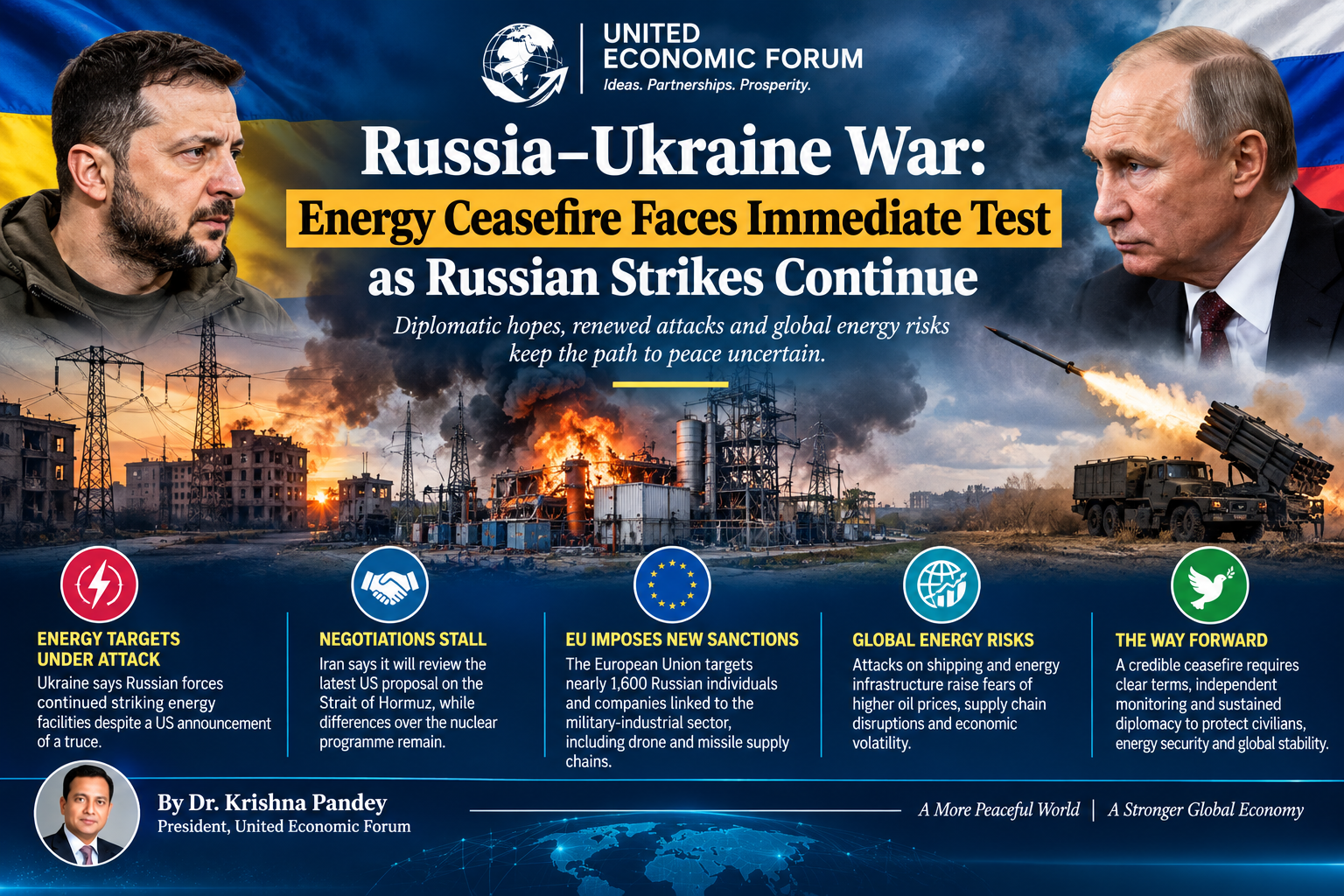
Russia–Ukraine War: Energy Ceasefire Faces Immediate Test as Russian Strikes Continue
Russia–Ukraine War: Energy Ceasefire Faces Immediate Test as Russian Strikes Continue
-
by Unitedforum
Share on:
Russia–Ukraine War: Energy Ceasefire Faces Immediate Test as Russian Strikes Continue
By Dr. Krishna Pandey
President, United Economic Forum
12 October 2026 | International Affairs | United Economic Forum
Renewed attacks on energy infrastructure, fresh European sanctions and uncertainty over US diplomacy raise questions about the prospects for peace
KYIV / MOSCOW — Hopes for a temporary reduction in hostilities between Russia and Ukraine have been challenged by renewed attacks on Ukrainian energy infrastructure, highlighting the fragile state of diplomatic efforts to end the war.
Ukrainian President Volodymyr Zelenskyy said on Monday that Russian forces continued striking energy facilities after US President Donald Trump announced that Moscow and Kyiv had agreed to stop targeting each other’s energy systems. Zelenskyy said Ukraine had refrained from attacking Russian energy infrastructure following the announcement and called on Washington to clarify and enforce the proposed arrangement.
The Kremlin has acknowledged that discussions concerning a possible energy ceasefire are continuing, but the terms and implementation of such an arrangement remain unclear. The latest developments underscore the gap between diplomatic announcements and conditions on the ground.
As the conflict approaches another winter, the security of electricity supplies, gas production, fuel distribution and civilian infrastructure is becoming increasingly urgent for Ukraine and its European partners.
Energy Infrastructure Remains a Major Battlefield
Attacks on power plants, gas facilities, fuel infrastructure and other essential services have become a defining feature of the conflict. Damage to these facilities can affect millions of civilians, disrupt industrial production and increase the burden on emergency services.
According to reporting published on 12 October, Ukrainian officials said Russian strikes had affected energy facilities, including a power plant in Kharkiv and a gas production site. Zelenskyy also reported a drone strike on a civilian gas station.
These developments raise concerns about the effectiveness of a proposed truce that lacks clearly communicated conditions and a publicly established enforcement mechanism.
For Ukraine, protecting energy infrastructure is essential not only for national security but also for maintaining public services, economic activity and civilian morale. For Russia, attacks on infrastructure and Ukrainian strikes against Russian energy assets form part of a wider confrontation over military capacity and economic resilience.
A sustainable ceasefire would require both sides to establish clear commitments, communicate violations promptly and agree on a credible process for investigating disputed incidents.
US Diplomacy Faces a Difficult Test
Washington continues to play a significant role in efforts to bring the two sides toward negotiations. However, the latest developments reveal the challenges involved in turning political announcements into an operational agreement.
The reported energy ceasefire has generated uncertainty because its precise terms have not been fully established publicly. Ukrainian officials have called for greater clarity, while European partners have expressed concern about the prospects for a reliable arrangement.
The issue has become more complicated following Trump's announcement of a deal allowing US purchases of Russian diesel under a sanctions waiver. Zelenskyy criticised the move, arguing that easing pressure on Moscow could encourage further military action. The decision has also prompted criticism from some US lawmakers.
These disagreements illustrate a central challenge in international mediation: diplomatic initiatives must be credible to the parties expected to implement them. Without clear terms, independent verification and consequences for violations, even a limited agreement can quickly lose momentum.
European Union Announces New Sanctions
The European Union announced another round of sanctions on 12 October targeting nearly 1,600 Russian individuals and companies linked to the country's military-industrial sector, including businesses associated with drone and missile production.
According to reporting by the Associated Press, the measures focus substantially on supply chains that provide components and technologies used in weapons production. The package also includes individuals accused of involvement in organising elections in Russian-occupied Ukrainian territories.
The sanctions reflect Europe's continued effort to restrict Russia's ability to sustain its military campaign. Their long-term impact, however, will depend on implementation, international cooperation and the ability to prevent sanctioned goods and technologies from reaching restricted end users through alternative channels.
For European governments, the policy challenge is to maintain pressure on Moscow while managing energy costs, defence spending and the economic consequences of prolonged conflict.
The Humanitarian and Economic Costs Continue
Beyond the battlefield, the war continues to impose severe costs on civilians and the wider economy.
Damage to energy infrastructure threatens heating, electricity and essential public services as temperatures begin to fall. Businesses face interruptions, households may experience higher living costs, and local authorities must allocate scarce resources to emergency repairs and reconstruction.
The conflict also affects food markets, transport corridors, insurance costs, investment decisions and public finances. Continued uncertainty makes it more difficult for companies to plan, for displaced people to return home and for Ukraine to rebuild damaged communities.
For neighbouring countries and international partners, the prolonged war requires sustained humanitarian assistance, support for refugees and investment in energy resilience.
Reconstruction will ultimately require more than financial resources. It will also depend on security guarantees, effective institutions, transparent procurement and a stable political environment.
What Is Needed for a Credible Ceasefire?
A workable energy ceasefire could be an important first step toward reducing civilian suffering and creating conditions for broader negotiations. However, a durable arrangement would need several essential elements.
First, clearly defined commitments. Both sides should identify which facilities and activities are covered, when restrictions begin and how the agreement applies to disputed or dual-use infrastructure.
Second, credible monitoring. A mutually acceptable process should allow alleged violations to be documented and reviewed. Publicly available information and independent verification would help reduce confusion and competing claims.
Third, civilian protection. Essential electricity, heating, water, healthcare and other civilian services should receive particular protection in accordance with international humanitarian law.
Fourth, sustained diplomacy. The United States, European governments and other international partners should encourage negotiations that address both immediate humanitarian needs and the broader security disputes underlying the war.
Finally, a path beyond temporary arrangements. An energy truce may reduce immediate risks, but it cannot by itself resolve territorial disputes, security guarantees or the political conditions necessary for a lasting settlement.
The Way Forward: Peace Must Be Measured by Results
The latest developments demonstrate that a ceasefire announcement alone cannot guarantee a reduction in violence. Its credibility depends on whether military operations change, civilians become safer and both sides follow verifiable commitments.
International leaders should therefore avoid treating preliminary diplomatic statements as a substitute for an implemented agreement. They should prioritise practical arrangements that can be monitored, communicate clearly about unresolved issues and maintain diplomatic channels even when negotiations encounter setbacks.
The international community must also prepare for the possibility that the war will continue into another difficult winter. Emergency energy support, humanitarian assistance and protection for essential infrastructure remain critical while diplomatic efforts proceed.
For Ukraine, Russia, Europe and the wider global economy, the stakes extend well beyond the immediate battlefield. Continued escalation risks deepening economic uncertainty and undermining regional security. A credible reduction in hostilities, by contrast, could provide relief to civilians and create the space needed for more comprehensive negotiations.
The central test is no longer simply whether a ceasefire can be announced, but whether it can be implemented, verified and sustained. Lasting peace will require political commitment, accountability and a recognition that the protection of civilian life must remain a priority.
About the Author
Dr. Krishna Pandey is President of the United Economic Forum and writes on international affairs, geopolitics, economic cooperation and sustainable development.
Editorial note: This article reflects publicly reported developments available on 12 October 2026. Statements about attacks and ceasefire compliance are attributed to the parties or news organisations reporting them. The terms of the proposed energy ceasefire remain unclear, and developments may change rapidly.
Sources for publication verification
Reuters — Kyiv says Russia hits energy targets despite Trump ceasefire — reporting on the alleged ceasefire violations and EU sanctions.
Associated Press — Zelenskyy says Russia strikes energy facilities despite Trump claim — reporting on Ukraine’s position and the uncertainty surrounding the proposed truce.
Associated Press — EU sanctions nearly 1,600 Russian people and firms linked to drone and missile parts — details of the latest EU measures.
Publication recommendation: Recheck official statements from Kyiv, Moscow, Washington and the EU immediately before publishing, particularly any updates on whether the energy ceasefire has been formally agreed and implemented.
Related post







Latest world's most important and pressing issues
more
Reports
Medical Tourism: Global Trend or Local Marvel? Exploring the Rise and Impact
Sep, 05, 2023
Unitedforum

Reports
Redefining Work and Wanderlust: The Era of Digital Nomads Revolutionizing Remote Work Culture
Sep, 05, 2023
Unitedforum
Upcoming events
Past events

EVENT
4th World Congress on Public Health and Nutrition
Welcome to the 4th World Congress on Public Health and Nutrition (Public Health 2019). It is a one-of-a-kind event showc...

EVENT
EPCC PAVILION- IMEX AMERICA
Show opening times Attendees: Doors are open to attendees from 9:00am to 6:00pm Tuesday October 17 and Wednesday Octobe...

EVENT
2nd World Congress on Patient Safety & Quality Healthcare
Conference Series extends its welcome to 2nd World Congress on Patient Safety & Quality Healthcare in Dublin, Ireland. W...



EVENT
EPCC- EUROPEAN MEDICAL TOURISM
Medical tourism, still little known in some countries (for example in Italy) is growing exponentially. In brief, it is...


EVENT
NOW- NATURAL ORGANIC WELNESS
Conference: September 21–22, 2023 Trade Show: September 23–24,2023

EVENT
Business Continuity Management Training Program
EPCC Global has been conducting five days training program on Business Continuity Management for Young Entrepreneurs.

EVENT
19th International Conference on Healthcare, Nutrition & Fitness Expo
Welcome to the 4th World Congress on Public Health and Nutrition (Public Health 2019). It is a one-of-a-kind event showc...