The Gulf at an Economic Crossroads: Can the UAE, Qatar and Saudi Arabia Withstand a Decade of Geopolitical Disruption?
The Gulf at an Economic Crossroads: Can the UAE, Qatar and Saudi Arabia Withstand a Decade of Geopolitical Disruption?
-
by Unitedforum
Share on:
The Gulf at an Economic Crossroads: Can the UAE, Qatar and Saudi Arabia Withstand a Decade of Geopolitical Disruption?
The Iran–Israel–USA Conflict and the Threat to GDP, Financial Stability, Employment and the Future of the Gulf Economy
Introduction: A Crisis Beyond the Battlefield
The escalating conflict involving Iran, Israel, and the United States has placed the Middle East at a critical economic crossroads. Beyond the immediate destruction and humanitarian consequences, a prolonged regional war could threaten the economic foundations of the Gulf Cooperation Council (GCC), particularly the United Arab Emirates (UAE), Qatar, and Saudi Arabia.
For decades, these countries have invested heavily in energy production, international finance, aviation, tourism, logistics, infrastructure, real estate, and economic diversification. Their cities have become international centers for business, investment, employment, and global connectivity.
Today, geopolitical instability threatens to undermine some of these achievements.
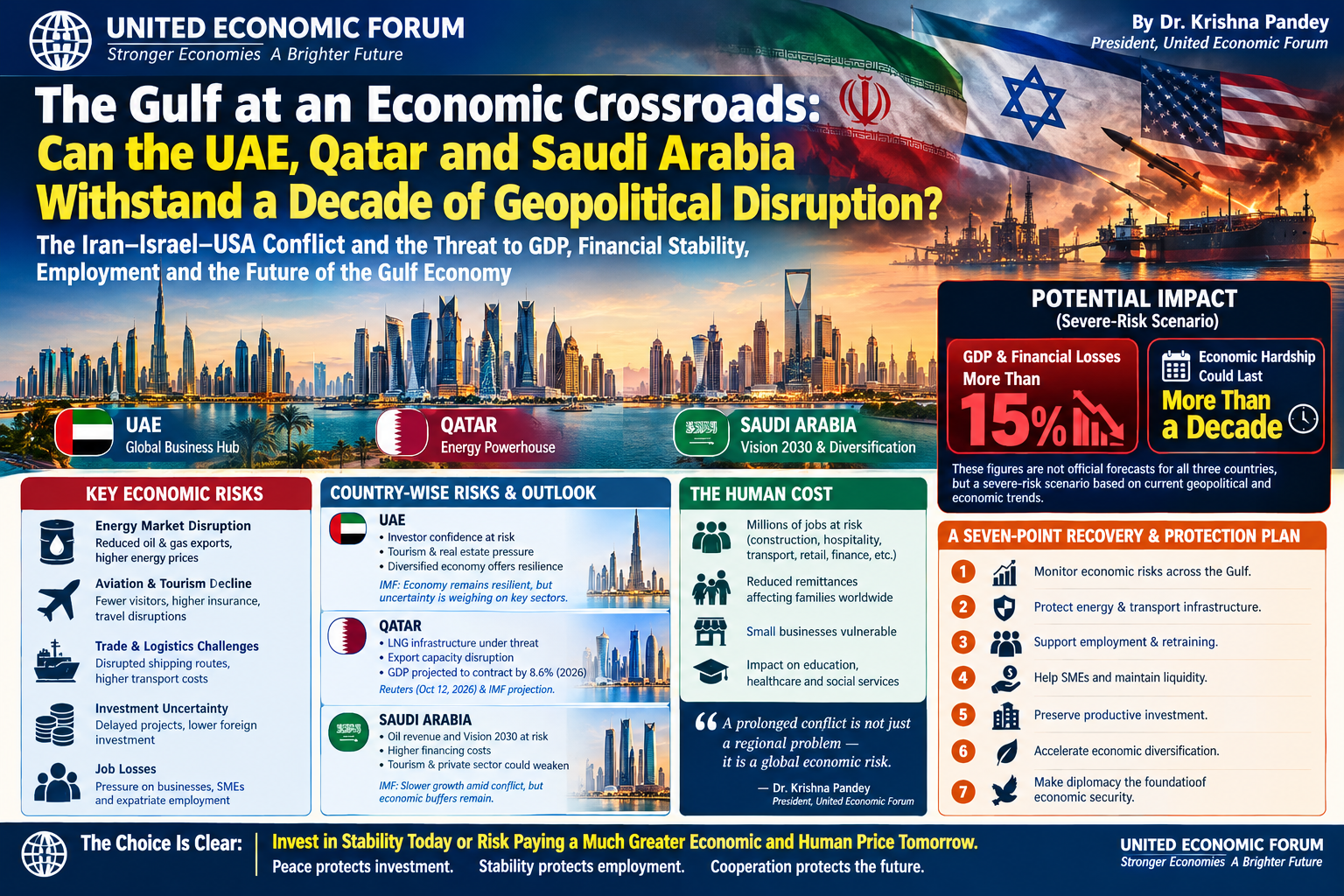
The possibility of economic losses exceeding 15% in severely affected sectors or individual economies must be taken seriously. However, such losses should be distinguished from a 15% contraction in total GDP. The scale of the actual damage will depend on the duration of the conflict, the security of energy infrastructure, the reopening of maritime routes, the strength of international investment, and the speed of recovery.
The International Monetary Fund's April 2026 regional outlook warned that conflict-related disruptions could substantially weaken growth across the region, with Qatar particularly exposed to energy infrastructure damage and disruptions to shipping through the Strait of Hormuz. [1]
The central concern is therefore not merely the immediate economic shock. It is whether prolonged instability could leave lasting damage to employment, investment, government finances, and the Gulf's long-term development ambitions.
1. The UAE: Protecting an International Business and Financial Hub
The United Arab Emirates has established itself as a global center for trade, aviation, tourism, real estate, financial services, logistics, and international investment.
Dubai and Abu Dhabi attract businesses and investors because of their infrastructure, international connectivity, regulatory environment, and reputation for stability.
A prolonged regional conflict could place these advantages under pressure through several channels.
Declining investor confidence: International businesses may delay investments or reconsider expansion if regional security risks remain elevated for an extended period.
Tourism and aviation disruption: Travel uncertainty, flight restrictions, higher insurance costs, and changes in visitor confidence could affect hotels, airlines, restaurants, retail businesses, and entertainment industries.
Real estate market pressure: If foreign investors become more cautious, demand for commercial properties, residential developments, and new construction projects could weaken.
Trade and logistics challenges: Disruption to maritime routes could increase transportation costs and interfere with the movement of goods through major ports and free zones.
Employment uncertainty: Businesses experiencing lower revenue may reduce recruitment, postpone expansion, or restructure operations.
Nevertheless, the UAE possesses important economic buffers, including diversified industries, established infrastructure, and the ability to redirect some trade flows. The IMF's July 2026 assessment described the economy as resilient while acknowledging that uncertainty was weighing on tourism, transport, trade, and real estate. [2]
The challenge is to preserve that resilience before temporary disruption becomes a long-term loss of competitiveness.
2. Qatar: The Strategic Importance of Energy Security
Qatar occupies a distinctive position in the global economy because of its importance in liquefied natural gas (LNG) production and exports.
Its energy industry supports government revenue, international trade, infrastructure development, and investment in education, healthcare, and public services.
When energy production or export capacity is disrupted, the effects can extend far beyond the energy sector.
Damage to LNG infrastructure may reduce export volumes, delay expansion projects, weaken expected revenues, and affect businesses that depend on energy-related investment. Shipping interruptions can further complicate the delivery of gas to international markets.
Reuters reported on October 12, 2026, that damage to Qatar's LNG infrastructure had significantly affected export capacity. The report cited an IMF projection of an 8.6% contraction in Qatar's GDP for 2026 under the prevailing conflict conditions. [3]
This illustrates how a geopolitical crisis can become a national economic emergency.
Qatar's long-term priorities should include protecting essential infrastructure, restoring export capacity safely, maintaining investor confidence, and supporting industries outside the energy sector.
The country must also consider how prolonged uncertainty could affect its LNG expansion plans and future international market position.
The longer production and shipping remain disrupted, the greater the risk that lost revenue and delayed projects will create economic consequences extending well beyond the immediate conflict.
3. Saudi Arabia: Protecting Vision 2030 and Economic Diversification
Saudi Arabia has undertaken an ambitious economic transformation through Vision 2030, seeking to expand tourism, entertainment, manufacturing, logistics, technology, renewable energy, and private-sector employment.
The strategy is designed to strengthen the economy beyond its traditional dependence on oil revenues.
However, prolonged regional instability could complicate this transformation.
First, disruptions to oil exports could affect government revenue and the resources available for major development projects. Higher oil prices may provide some compensation, but they cannot always offset reduced export volumes, higher shipping costs, or damage to infrastructure.
Second, international investors may demand higher returns to compensate for increased geopolitical risk. This could raise the cost of financing projects and delay investment decisions.
Third, tourism, hospitality, aviation, and international events depend on security, confidence, and reliable transport links. A sustained regional crisis could make these industries more difficult to develop.
Fourth, uncertainty may affect small and medium-sized enterprises that depend on government contracts, international visitors, domestic consumption, or foreign investment.
The IMF's July 2026 assessment projected slower Saudi economic growth amid the conflict but also highlighted the country's economic buffers, diversified oil and logistics infrastructure, and capacity to redirect some exports through Red Sea ports. [4]
Saudi Arabia therefore faces a serious challenge, but not an inevitable economic collapse. Protecting diversification, maintaining financial discipline, and supporting productive private-sector employment will be essential to sustaining progress.
4. Could Economic Losses Exceed 15% GDP?
The possibility of losses exceeding 15% should be considered within a clear economic framework.
A fall of more than 15% in a particular industry's revenue, export capacity, financial-market value, or economic output is not equivalent to a 15% contraction in the entire national economy.
This distinction is particularly important when discussing the UAE, Qatar, and Saudi Arabia, whose economies have different structures and levels of exposure.
A severe-risk scenario could involve:
Major interruptions to energy production and exports.
Prolonged disruption to maritime trade and international aviation.
Significant reductions in tourism and real estate activity.
Delays or cancellations of foreign investment projects.
Higher borrowing costs and reduced business confidence.
Worsening public finances and pressure on private-sector employment.
If several of these shocks occurred simultaneously and continued for an extended period, the combined consequences could be substantial.
Qatar's projected GDP contraction in 2026 demonstrates the seriousness of the current risks, while the UAE and Saudi Arabia have shown different degrees of resilience. The IMF's regional assessment also emphasizes that economic damage varies considerably across countries.
The United Economic Forum therefore urges governments and international financial institutions to publish regular stress tests covering energy exports, fiscal revenue, banking stability, investment, employment, and alternative conflict scenarios.
Responsible forecasting must distinguish between what is already observed, what is projected, and what remains a worst-case possibility.
5. The Employment Crisis: A Threat to Millions of Livelihoods
One of the most serious long-term consequences of an extended economic downturn could be pressure on employment.
The Gulf economies support large workforces across construction, retail, hospitality, transport, finance, manufacturing, domestic services, and professional industries.
If businesses face prolonged revenue losses, they may freeze recruitment, reduce working hours, postpone projects, or eliminate positions.
Construction workers could be affected by delayed developments. Hospitality employees could face reduced demand. Transport and logistics workers could experience lower activity. Financial and professional services could face weaker demand if companies postpone expansion.
Small businesses may be particularly vulnerable because they often have less access to financing and fewer reserves to withstand a prolonged downturn.
For expatriate workers, declining employment opportunities could also mean reduced remittances to families in their countries of origin. This would transmit the economic effects of the Gulf crisis to South Asia, Africa, and other regions.
Governments and employers should therefore strengthen employment protection, improve retraining opportunities, expand support for viable small businesses, and identify vulnerable industries before widespread job losses occur.
The objective must be to prevent a temporary geopolitical shock from turning into a prolonged crisis of livelihoods.
6. Could the Economic Consequences Last More Than a Decade?
A decade of economic hardship is a serious possibility that policymakers should examine, but it is not an inevitable outcome for the UAE, Qatar, or Saudi Arabia.
The duration of economic damage depends on the severity of infrastructure losses, the continuity of trade disruption, the cost of restoring production, investor confidence, and the effectiveness of government policy.
A country may restore its annual GDP growth relatively quickly while still suffering lasting damage to employment, public finances, household incomes, or investment.
For example, a major energy facility may require extensive repairs. An international company may relocate an investment project. A tourism business may close permanently. A delayed infrastructure project may reduce productivity for years.
Such effects can accumulate and slow economic progress even after hostilities end.
The IMF has noted that severe and prolonged conflicts across the broader Middle East can leave income per person significantly below its pre-conflict trajectory years later. This is evidence of the potential for lasting economic scarring, rather than a prediction that all three Gulf economies will experience a decade of contraction.
The most important lesson is that recovery requires more than a ceasefire. It requires reliable security, functioning infrastructure, renewed international confidence, and sustained investment in productive economic activity.
7. Financial Stability: Preventing a Regional Shock from Becoming a Banking Crisis
The Gulf's financial systems are central to economic stability. Banks provide credit to households, businesses, infrastructure projects, and international enterprises.
A prolonged downturn could weaken loan demand, increase repayment difficulties for exposed businesses, reduce asset values, and make lenders more cautious.
Financial markets may also experience sharp fluctuations as investors reassess regional risk.
Governments and financial regulators should monitor liquidity, credit exposure, corporate debt, property-market risks, and the concentration of lending in vulnerable industries.
Stress testing should examine scenarios involving lower export revenues, prolonged shipping disruption, falling tourism receipts, and delayed real estate projects.
At the same time, authorities should avoid unnecessary panic. Financial systems can withstand significant pressure when they have adequate capital, liquidity, credible supervision, and well-designed contingency arrangements.
Maintaining transparent communication will be crucial to preserving public confidence.
8. A Seven-Point Economic Recovery and Protection Plan
The United Economic Forum recommends coordinated action by the governments of the UAE, Qatar, and Saudi Arabia, together with regional partners and international institutions.
1. Establish a Gulf economic-risk monitoring mechanism.
Governments should coordinate assessments of GDP, export volumes, shipping activity, investment flows, employment, inflation, and banking stability.
2. Protect energy and transport infrastructure.
Essential facilities should be protected in accordance with international law, with emergency plans for restoring production and maintaining safe commercial shipping.
3. Introduce targeted employment support.
Temporary assistance, retraining, and job-placement programs should focus on workers and industries most exposed to conflict-related disruption.
4. Support viable small and medium-sized businesses.
Where appropriate, governments and financial institutions should provide temporary liquidity assistance, restructuring options, and access to credit for businesses facing exceptional shocks.
5. Preserve productive investment.
Development priorities should be reviewed transparently, protecting essential infrastructure, education, healthcare, technology, and projects that strengthen long-term productivity.
6. Accelerate economic diversification.
The UAE, Qatar, and Saudi Arabia should continue expanding competitive non-oil industries, including technology, advanced manufacturing, renewable energy, professional services, and sustainable tourism.
7. Make diplomacy the foundation of economic security.
Regional governments and international partners should pursue de-escalation, protect civilians, maintain communication channels, and support a durable political settlement.
Economic recovery will be much more difficult if security risks remain unresolved.
9. The Responsibility of International Leadership
The United States, Iran, Israel, and regional governments must recognize that military confrontation carries consequences far beyond the battlefield.
The Gulf is a vital center of international energy production, investment, logistics, and trade. A prolonged crisis can affect consumers, workers, investors, and businesses around the world.
International institutions should help assess economic damage, coordinate humanitarian support, and prepare recovery financing where necessary.
Governments should also resist policies that unnecessarily restrict essential trade, worsen humanitarian conditions, or undermine the confidence required for economic recovery.
The UAE, Qatar, and Saudi Arabia have substantial interests in regional stability. Their diplomatic engagement, economic cooperation, and support for practical de-escalation could help reduce the risk of a much wider crisis.
The global business community must recognize that peace is not merely a political preference. It is an essential condition for long-term investment and sustainable economic development.
Conclusion: Preventing a Lost Decade for the Gulf
The Iran–Israel–USA conflict presents the Gulf region with a defining economic challenge.
The UAE must protect its position as a global business and financial hub. Qatar must safeguard its energy-export capacity and long-term LNG strategy. Saudi Arabia must preserve the momentum of Vision 2030 while maintaining investment and employment.
All three countries face risks from prolonged instability, but their economic exposure, financial resources, and recovery prospects differ.
Potential losses exceeding 15% in severely affected sectors or under extreme national economic scenarios deserve serious attention. A decade of economic hardship is likewise a risk to be prevented, not a predetermined future.
The international community should act before the cumulative effects of conflict damage infrastructure, weaken employment, discourage investment, and undermine years of economic progress.
The United Economic Forum calls for immediate de-escalation, regional cooperation, protection of civilian lives, financial resilience, and a coordinated Gulf economic recovery strategy.
The choice is clear: invest in stability today or risk paying a much greater economic and human price tomorrow.
Peace protects investment. Stability protects employment. Cooperation protects the future.
Dr. Krishna Pandey
President, United Economic Forum
References
International Monetary Fund, Regional Economic Outlook Update: Middle East and Central Asia — War in the Middle East: Economic Spillovers and Policy Challenges, April 2026. Read the report
International Monetary Fund, IMF Staff Concludes Visit to United Arab Emirates, July 17, 2026. Read the assessment
Reuters, Middle East LNG Industry Remains Hostage of Iran War, October 12, 2026. Read the report
International Monetary Fund, IMF Executive Board Concludes 2026 Article IV Consultation with Saudi Arabia, July 29, 2026. Read the assessment
Related post






Latest world's most important and pressing issues
more
Reports
Medical Tourism: Global Trend or Local Marvel? Exploring the Rise and Impact
Sep, 05, 2023
Unitedforum

Reports
Redefining Work and Wanderlust: The Era of Digital Nomads Revolutionizing Remote Work Culture
Sep, 05, 2023
Unitedforum
Upcoming events
Past events

EVENT
4th World Congress on Public Health and Nutrition
Welcome to the 4th World Congress on Public Health and Nutrition (Public Health 2019). It is a one-of-a-kind event showc...

EVENT
EPCC PAVILION- IMEX AMERICA
Show opening times Attendees: Doors are open to attendees from 9:00am to 6:00pm Tuesday October 17 and Wednesday Octobe...

EVENT
2nd World Congress on Patient Safety & Quality Healthcare
Conference Series extends its welcome to 2nd World Congress on Patient Safety & Quality Healthcare in Dublin, Ireland. W...



EVENT
EPCC- EUROPEAN MEDICAL TOURISM
Medical tourism, still little known in some countries (for example in Italy) is growing exponentially. In brief, it is...


EVENT
NOW- NATURAL ORGANIC WELNESS
Conference: September 21–22, 2023 Trade Show: September 23–24,2023

EVENT
Business Continuity Management Training Program
EPCC Global has been conducting five days training program on Business Continuity Management for Young Entrepreneurs.

EVENT
19th International Conference on Healthcare, Nutrition & Fitness Expo
Welcome to the 4th World Congress on Public Health and Nutrition (Public Health 2019). It is a one-of-a-kind event showc...