Nepal’s Billion-Dollar Hydropower Sector Under Threat as Climate Risks Intensify
Nepal’s Billion-Dollar Hydropower Sector Under Threat as Climate Risks Intensify
-
by Unitedforum
Share on:
Nepal’s Billion-Dollar Hydropower Sector Under Threat as Climate Risks Intensify
By Dr. Krishna Pandey
President, United Economic Forum
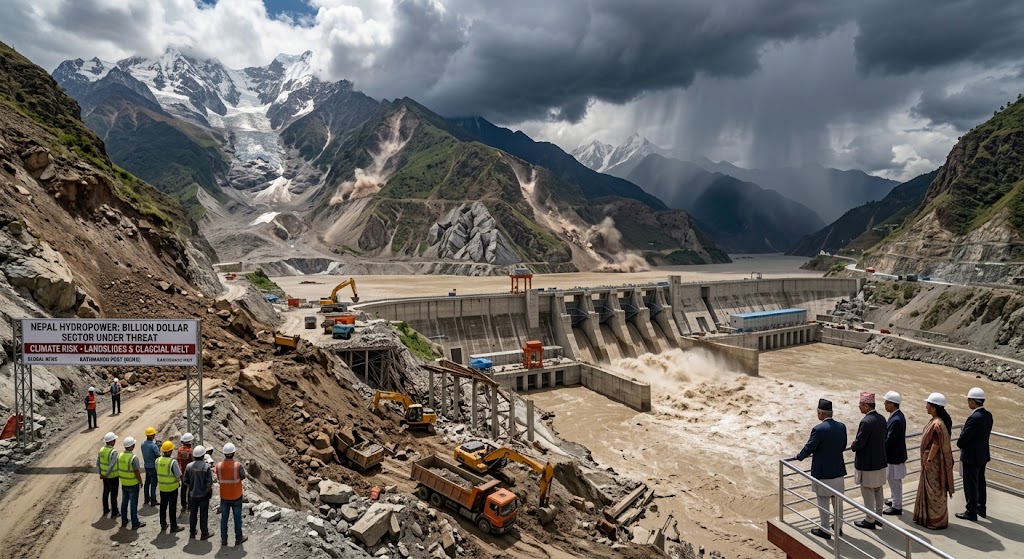
KATHMANDU, Nepal — Nepal’s ambition to become a major regional hydropower producer is facing a critical test as devastating floods, landslides, and growing climate-related hazards expose the vulnerabilities of its energy infrastructure. Recent disasters in the Bhote Koshi and Kaligandaki corridors have demonstrated how extreme natural events can disrupt electricity generation, damage transmission networks, threaten investment returns, and impose substantial costs on the national economy.
The events have raised an urgent question for policymakers, investors, and development partners: can Nepal safeguard its multibillion-dollar hydropower ambitions without fundamentally strengthening climate resilience and disaster-risk management?
Nepal possesses enormous hydropower potential, and electricity exports offer opportunities to generate foreign exchange, attract investment, create employment, and deepen regional economic cooperation. However, these opportunities depend on the safety and reliability of the infrastructure that supports electricity generation and transmission.
The recent disasters should therefore be understood not simply as isolated emergencies, but as warnings about the economic consequences of failing to adequately account for climate and geological risks in national development planning.
Bhote Koshi floods: A devastating warning for hydropower investment
On 26 August 2026, severe flash flooding affected communities and infrastructure along the Bhote Koshi and Trishuli river corridors after a sudden surge of water in the Rasuwa region. Preliminary assessments indicated that the event may have involved an upstream ice avalanche and temporary damming of the Lhende River, although the precise mechanisms and contributing factors require careful scientific assessment.
According to Nepal’s Ministry of Foreign Affairs, preliminary assessments identified damage to 13 hydropower projects, one solar power plant, and two transmission lines. Approximately 783 megawatts of hydropower generation capacity were affected, alongside extensive damage to roads, bridges, homes, and public infrastructure.
The World Bank subsequently reported that 12 hydropower projects were affected, including seven operational projects with a combined capacity of 256.1 MW and five projects under construction with a combined capacity of 395.02 MW. Damage to transmission infrastructure also disrupted electricity delivery.
The financial implications are significant. Reporting by The Kathmandu Post indicated that preliminary estimates of damage to hydropower projects and transmission infrastructure could reach hundreds of billions of Nepali rupees, although the final costs of reconstruction and insurance recovery remain uncertain.
These figures highlight the exposure of Nepal’s energy sector to disasters that can simultaneously damage generating facilities, interrupt access roads, undermine transmission infrastructure, and delay projects that have already absorbed substantial capital.
For investors, the consequences extend beyond physical damage. Extended shutdowns can reduce electricity revenues, delay debt repayment, increase insurance costs, and undermine confidence in future projects. For the government, reconstruction can create additional fiscal pressure while reducing the economic benefits expected from energy exports.
The Bhote Koshi disaster demonstrates why hydropower planning must incorporate comprehensive assessments of upstream hazards, sediment movement, slope instability, river behaviour, and cascading infrastructure failures.
Kaligandaki corridor: When transmission infrastructure becomes the weakest link
The second major warning emerged in the Kaligandaki corridor in September 2026.
On 28 September, landslides triggered by persistent rainfall damaged transmission pylons along the Dana–Kushma section of the 220-kilovolt transmission line. According to reporting by The Kathmandu Post, 12 hydropower plants with a combined capacity of 358.2 MW were forced to shut down. Including additional projects taken offline as a precaution, more than 790 MW of generation capacity was temporarily knocked out of the national grid. <Cite refs={["turn148177search2"]}/>
This incident illustrates a critical weakness in Nepal’s energy development model: generating electricity is not enough if the transmission network cannot reliably deliver it to consumers and markets.
A single vulnerable transmission corridor can affect multiple power plants, even when their generating equipment remains intact. Landslides, damaged access roads, unstable slopes, and difficult mountain terrain can also delay repairs and increase restoration costs.
The implications are particularly important for Nepal’s export ambitions. Electricity trade depends on dependable delivery schedules, functioning transmission systems, and confidence among buyers. Repeated disruptions can affect revenue forecasts, contractual performance, and the perceived reliability of Nepal as a regional energy supplier.
The lesson from Kaligandaki is clear: transmission infrastructure must receive the same level of climate-risk assessment, engineering attention, and financial protection as hydropower generating facilities.
Climate change is intensifying an already complex risk environment
Nepal’s mountain environment is naturally exposed to earthquakes, landslides, intense rainfall, and river flooding. Not every disaster can be attributed directly to climate change, and the specific causes of individual events require scientific investigation.
Nevertheless, climate change is increasing important risks across the Himalayan region. Rising temperatures contribute to glacier retreat and changes in snow and ice conditions. Changes in precipitation, more intense rainfall in some circumstances, and the growth of potentially dangerous glacial lakes can increase hazards for downstream settlements and infrastructure.
The United Nations Development Programme identifies glacial lake outburst floods and climate-related flooding as serious threats to Nepal’s communities, hydropower facilities, tourism assets, agricultural land, and ecosystems. Its ongoing work includes improving monitoring, early-warning systems, and risk reduction in priority glacial river basins.
For hydropower developers, the challenge is not limited to catastrophic floods. Changing river flows can affect seasonal generation, while heavy sediment loads can damage turbines and other equipment. Landslides can destroy access roads, pipelines, transmission towers, and supporting infrastructure.
These risks must be considered across the entire life cycle of a hydropower project—from site selection and financing to construction, operation, maintenance, and eventual decommissioning.
Climate change should therefore be incorporated into project feasibility studies and financial models rather than treated as a secondary environmental issue.
The economic stakes: Protecting billions in investment
Nepal’s hydropower ambitions involve substantial public and private investment. Projects require capital for civil engineering, tunnels, dams, turbines, transmission systems, access roads, and environmental management.
When disasters damage these assets, the consequences can spread throughout the economy.
First, electricity production and sales may decline, reducing revenue for developers and the wider economy.
Second, reconstruction can require additional borrowing, fresh equity, insurance payouts, or government support. Where coverage is incomplete or exclusions apply, investors and project sponsors may face substantial losses.
Third, prolonged power disruptions can affect industries, businesses, employment, and government revenue.
Fourth, repeated infrastructure failures may increase the cost of financing future projects if lenders and insurers perceive Nepal’s hydropower sector as carrying greater risks.
Finally, disruptions to export infrastructure can weaken Nepal’s ability to convert its natural resources into foreign exchange and long-term economic growth.
The concern is not that every hydropower project is destined to fail. Rather, it is that insufficient preparation for foreseeable hazards could place a growing portfolio of valuable investments at unnecessary risk.
Protecting existing assets may be just as economically important as financing new generating capacity.
A new national priority: Climate-resilient hydropower
Nepal must now move from a predominantly construction-focused approach to a comprehensive strategy that places resilience, safety, and long-term asset protection at the centre of hydropower development.
1. Make climate-risk assessments mandatory and meaningful.
Every major hydropower project should undergo rigorous assessments of flood hazards, glacial lake risks, landslide exposure, sediment loads, seismic conditions, and future changes in hydrology. These assessments should inform design standards, site selection, contingency planning, and financing decisions.
2. Strengthen early-warning and monitoring systems.
Nepal should expand real-time monitoring of rainfall, river levels, glaciers, glacial lakes, and unstable slopes. Where risks cross national borders, cooperation with neighbouring countries should support timely data exchange and disaster warnings.
3. Protect transmission corridors.
Transmission lines and substations require improved slope stabilisation, drainage, hazard mapping, engineering redundancy, and alternative routing where technically and economically feasible. Critical infrastructure should be designed to reduce the possibility that one damaged corridor disables multiple generating facilities.
4. Establish dedicated disaster-risk financing.
Hydropower developers, lenders, insurers, and government agencies should work together to strengthen insurance coverage, emergency financing, disaster-response arrangements, and recovery plans. Risk allocation should be transparent and reflect the actual hazards faced by each project.
5. Review construction and environmental standards.
Environmental impact assessments should incorporate forward-looking climate scenarios and cumulative river-basin impacts. Independent technical reviews should verify that engineering assumptions remain appropriate as new scientific evidence becomes available.
6. Improve coordination between government and investors.
The government, Nepal Electricity Authority, independent power producers, financial institutions, and local authorities need coordinated mechanisms for emergency response, infrastructure inspections, information sharing, and rapid restoration of electricity services.
7. Build climate resilience into project economics.
Developers and lenders should evaluate the cost of resilience against the potential costs of reconstruction, lost revenue, and prolonged shutdowns. A project with a slightly higher initial cost may deliver substantially better long-term economic value if it can withstand extreme events more effectively.
Himalayan diplomacy: Regional cooperation is an economic necessity
Nepal’s climate and hydropower challenges cannot be addressed through domestic policy alone. Rivers, glaciers, weather systems, and disaster risks cross political boundaries.
Cooperation with China is important for upstream hazard monitoring and timely information about events that may affect Nepal’s northern river systems. Cooperation with India is essential for cross-border electricity trade, transmission connectivity, and shared river-basin management. Bangladesh also has a significant interest in regional energy cooperation and the long-term sustainability of South Asian water systems.
Nepal should use its diplomatic relationships to establish stronger mechanisms for scientific cooperation, emergency communication, hydrological data sharing, and disaster preparedness.
Such arrangements should be based on mutual respect, technical evidence, transparent procedures, and the shared interest in protecting lives and economic infrastructure.
International climate finance and technical assistance can also help Nepal strengthen monitoring systems, modernise infrastructure, and improve preparedness in vulnerable mountain regions.
The objective should be to make Himalayan cooperation a practical mechanism for reducing economic losses rather than merely a subject of diplomatic discussion.
The United Economic Forum’s perspective
From the perspective of the United Economic Forum, the recent disasters highlight the need to connect environmental security with economic planning and investment policy.
Nepal’s hydropower sector has the potential to support industrial development, regional electricity markets, employment, and long-term economic prosperity. However, this potential can only be realised if projects are designed and managed with a realistic understanding of climate and geological risks.
Dr. Krishna Pandey, President of the United Economic Forum, emphasises the importance of treating climate resilience as a core component of Nepal’s economic security agenda.
The policy priority should be to protect the value already invested in the country’s energy infrastructure while ensuring that future projects meet robust standards of safety, sustainability, and financial viability.
The United Economic Forum can help advance this agenda by bringing together government representatives, energy developers, financial institutions, researchers, investors, and international development partners to discuss practical reforms and investment opportunities.
A resilient hydropower sector would benefit not only project developers but also electricity consumers, local communities, workers, government finances, and Nepal’s regional economic partners.
Conclusion: Nepal must protect its energy future before the next disaster
The Bhote Koshi floods and the Kaligandaki transmission disruption have delivered a powerful warning. Nepal’s hydropower future depends not only on its rivers and generating capacity but also on the resilience of the entire infrastructure network that supports electricity production and distribution.
Climate-related hazards, combined with Nepal’s challenging mountain geography, make it essential to strengthen engineering standards, improve early-warning systems, protect transmission corridors, and ensure that project financing accounts for long-term environmental risks.
The economic cost of inaction could be substantial. Damaged infrastructure, lost electricity revenue, delayed projects, higher insurance premiums, and expensive reconstruction could weaken the benefits Nepal expects from its hydropower investments.
The solution is not to abandon hydropower development. It is to make that development safer, more sustainable, and more financially resilient.
Nepal’s hydropower ambition must now be matched by an equally ambitious commitment to climate resilience. Protecting energy infrastructure is no longer simply an engineering responsibility; it is a national economic priority and a foundation for the country’s long-term prosperity.
Published for the United Economic Forum.
About the author: Dr. Krishna Pandey is the President of the United Economic Forum. His policy perspective focuses on economic development, investment security, geopolitics, regional cooperation, and sustainable prosperity.
Sources and further reading
World Bank — Nepal Development Update: August 2026 Flood and Its Transmission Channels to Nepal’s Economy.
The Kathmandu Post — Flood damage to Nepal’s hydropower sector could run into billions, 30 August 2026.
The Kathmandu Post — Landslides knock 358MW offline in Kaligandaki corridor, 28 September 2026.
Ministry of Foreign Affairs, Government of Nepal — Daily Situation Update on Bhote Koshi River Floods, 6 September 2026.
United Nations Development Programme — Protecting livelihoods and assets at risk from glacial lake outburst floods and climate change-induced flooding.
Related post







Latest world's most important and pressing issues
more
Reports
Medical Tourism: Global Trend or Local Marvel? Exploring the Rise and Impact
Sep, 05, 2023
Unitedforum

Reports
Redefining Work and Wanderlust: The Era of Digital Nomads Revolutionizing Remote Work Culture
Sep, 05, 2023
Unitedforum
Upcoming events
Past events

EVENT
4th World Congress on Public Health and Nutrition
Welcome to the 4th World Congress on Public Health and Nutrition (Public Health 2019). It is a one-of-a-kind event showc...

EVENT
EPCC PAVILION- IMEX AMERICA
Show opening times Attendees: Doors are open to attendees from 9:00am to 6:00pm Tuesday October 17 and Wednesday Octobe...

EVENT
2nd World Congress on Patient Safety & Quality Healthcare
Conference Series extends its welcome to 2nd World Congress on Patient Safety & Quality Healthcare in Dublin, Ireland. W...



EVENT
EPCC- EUROPEAN MEDICAL TOURISM
Medical tourism, still little known in some countries (for example in Italy) is growing exponentially. In brief, it is...


EVENT
NOW- NATURAL ORGANIC WELNESS
Conference: September 21–22, 2023 Trade Show: September 23–24,2023

EVENT
Business Continuity Management Training Program
EPCC Global has been conducting five days training program on Business Continuity Management for Young Entrepreneurs.

EVENT
19th International Conference on Healthcare, Nutrition & Fitness Expo
Welcome to the 4th World Congress on Public Health and Nutrition (Public Health 2019). It is a one-of-a-kind event showc...