The Iran–Israel–USA Crisis: A Looming Economic Shock for the Middle East and the United States
The Iran–Israel–USA Crisis: A Looming Economic Shock for the Middle East and the United States
-
by Unitedforum
Share on:
The Iran–Israel–USA Crisis: A Looming Economic Shock for the Middle East and the United States
A Regional Conflict with Global Consequences
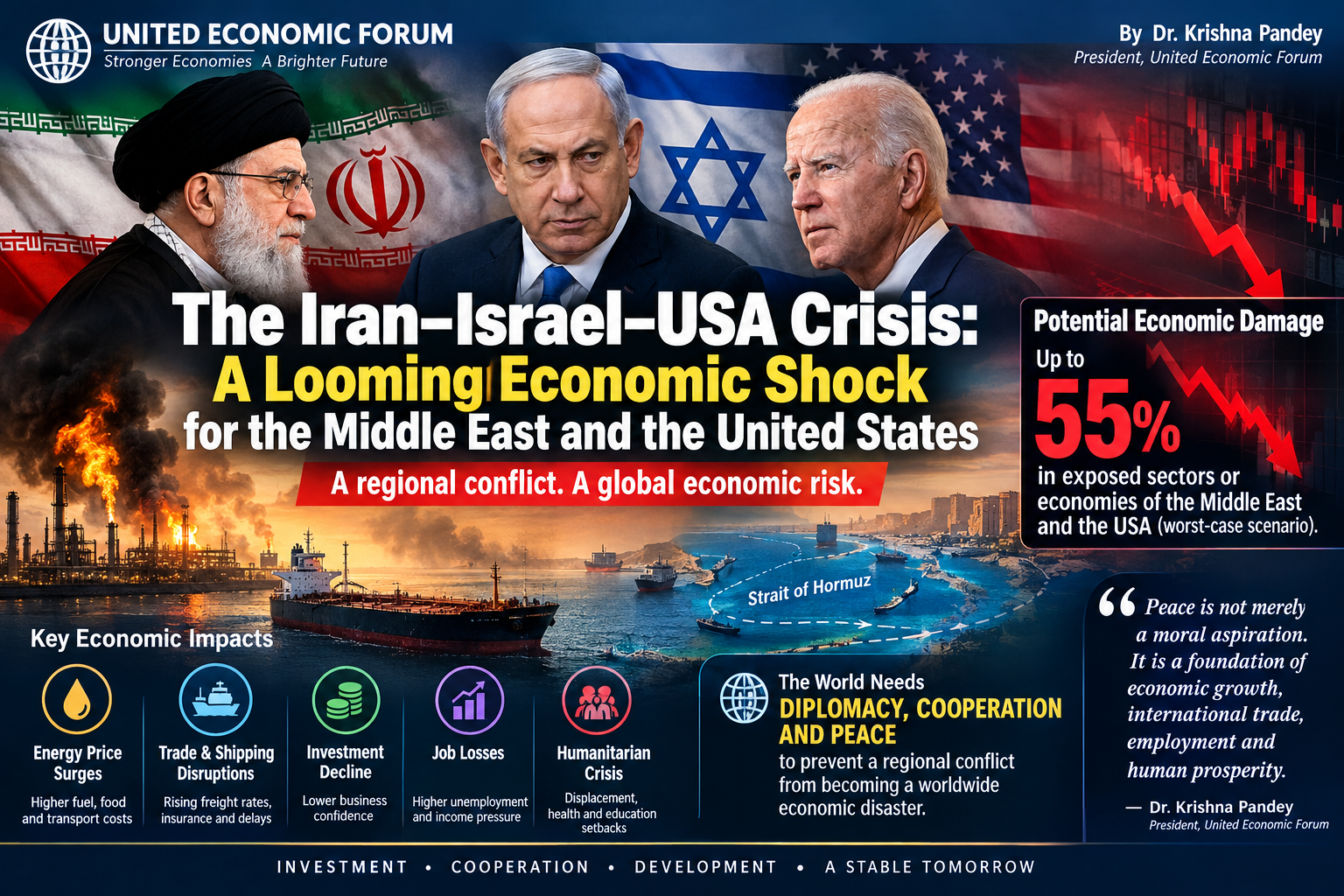
The escalating tensions involving Iran, Israel, and the United States represent far more than a regional security challenge. They pose a serious threat to international trade, energy security, financial stability, investment, employment, and the economic well-being of millions of people across the world.
The Middle East occupies a strategic position in the global economy. It is a major source of oil and natural gas, a critical corridor for international shipping, and an important destination for global investment. The United States, meanwhile, plays a central role in international finance, technology, investment, and global commerce. A prolonged confrontation among these powers could therefore transmit economic shocks across continents.
There is growing concern that an extreme escalation could cause economic damage on an unprecedented scale. The possibility of losses reaching as much as 55% in particular economies or economic sectors deserves serious examination. However, such a figure should be treated as a worst-case warning scenario, not an established forecast for the entire Middle Eastern or American economy. The actual consequences would depend on the duration and intensity of the conflict, the extent of damage to energy infrastructure, disruptions to shipping, and the international community's ability to restore stability.
The central question is no longer simply who will prevail militarily. It is whether the international community can prevent a geopolitical confrontation from becoming a historic economic disaster.
1. The Middle East: The Economic Cost of Prolonged Conflict
For Middle Eastern economies, a prolonged conflict could undermine the foundations of economic growth.
Oil and gas exports are vital to several regional economies, while tourism, aviation, logistics, manufacturing, construction, and international investment contribute substantially to economic diversification. Military escalation threatens all these activities.
The potential consequences include:
Energy infrastructure disruption: Damage to oil fields, refineries, pipelines, export terminals, and gas facilities could reduce production and disrupt global supply.
Shipping and logistics instability: Risks to maritime routes could increase freight rates, insurance premiums, delivery times, and the cost of essential imports.
Declining investor confidence: Businesses may postpone or cancel projects when political and security risks become unpredictable.
Tourism and aviation losses: Travel restrictions, flight cancellations, and perceptions of insecurity could affect airlines, hotels, restaurants, and related industries.
Employment and household pressures: Higher living costs and reduced business activity could threaten jobs, wages, and family purchasing power.
The effects would not be uniform. Some energy exporters might temporarily benefit from higher oil prices, while energy importers and economies dependent on tourism or trade could face severe pressures. Even countries outside the immediate conflict zone could suffer through financial markets, supply chains, and reduced regional commerce.
2. The United States: Why Distance Does Not Provide Economic Protection
The United States is geographically distant from much of the conflict, but its economy remains deeply connected to global energy markets, international investment, and geopolitical stability.
A sustained confrontation could affect American households and businesses through several channels.
Energy prices and inflation: A significant disruption to global oil supplies could raise gasoline, diesel, transportation, and production costs. Higher energy prices can feed into food prices and the cost of delivering goods and services.
Interest rates and financial markets: Heightened uncertainty can increase market volatility, affect investor confidence, and complicate decisions by businesses and financial institutions. If inflationary pressures intensify, monetary policymakers could face difficult choices between containing inflation and supporting economic growth.
Government expenditure and public debt: A prolonged military confrontation could increase defense and security spending. Additional expenditure may place pressure on public finances, particularly if economic growth weakens at the same time.
Business investment and employment: Companies facing uncertain demand, expensive inputs, or disrupted supply chains may delay expansion, reduce hiring, or reconsider international operations.
Consumer confidence: If households experience higher fuel bills, rising prices, and falling investment values, they may reduce discretionary spending. That reduction can further weaken economic activity.
Nevertheless, the United States has a large and diversified economy, domestic energy production, deep financial markets, and substantial institutional capacity. A severe regional conflict would not automatically translate into a comparable contraction of the entire American economy. The scale of the damage would depend on how long the crisis lasted and whether it expanded into a broader disruption of global trade and energy supplies.
3. Could the Economic Damage Reach 55%?
The possibility of an economic shock approaching 55% must be addressed with analytical discipline.
A decline of that magnitude in total annual economic output would constitute an extraordinary economic collapse for a major economy. It should not be presented as the expected outcome without a clearly defined model, a specified period, and credible supporting evidence.
The distinction between different economic indicators is essential. A 55% fall in the value of a particular stock market index, a decline in a vulnerable industry's revenue, a reduction in investment, and a 55% contraction in gross domestic product are fundamentally different outcomes.
The United Economic Forum therefore calls for rigorous scenario analysis examining three broad possibilities:
Limited escalation: Temporary energy-price volatility, higher insurance costs, and localized trade disruption, followed by gradual stabilization.
Prolonged regional conflict: Sustained energy-market uncertainty, weaker investment, elevated inflation, pressure on public finances, and reduced regional growth.
Severe systemic shock: Extensive damage to critical infrastructure, prolonged disruption to major maritime routes, widespread regional instability, and a sharp deterioration in global financial and economic conditions.
The third scenario could produce exceptionally severe losses in exposed industries and individual economies. However, the precise magnitude must be established through transparent economic modeling rather than speculation.
The purpose of raising the 55% possibility is to encourage preventive action, not to create panic. Responsible leadership requires that worst-case scenarios be examined before they become reality.
4. Energy Security: The Strategic Vulnerability
One of the most consequential risks is disruption to energy flows through the Persian Gulf and the Strait of Hormuz, a vital passage for international oil and gas shipments.
A prolonged interruption could create a chain reaction throughout the global economy. Energy shortages or sharp price increases could raise the cost of electricity, manufacturing, agriculture, transportation, and international shipping.
For oil-importing nations, this could widen trade deficits and increase inflation. For developing countries, higher fuel and food costs could place additional pressure on foreign-exchange reserves and government budgets. For energy-intensive industries, rising costs could reduce competitiveness and employment.
Even the threat of disruption can be economically damaging. Shipping companies may reroute vessels, insurers may increase premiums, and businesses may build expensive inventories or postpone deliveries.
The international community must therefore prioritize the protection of civilian infrastructure, the security of maritime commerce, and reliable access to essential energy supplies. Emergency coordination among energy producers, importers, shipping operators, and international institutions would help limit the effects of a supply shock.
5. The Human Cost: Beyond GDP and Financial Markets
Economic analysis must never lose sight of the human consequences of war.
Behind every decline in production or investment are workers whose employment may disappear, families whose purchasing power may diminish, and small businesses that may be unable to survive prolonged uncertainty.
Conflict can displace communities, interrupt education, weaken healthcare systems, and divert public resources from development toward emergency response. The effects may persist long after military operations cease.
The most vulnerable groups are often those with the least capacity to absorb higher prices or income losses: low-income households, migrant workers, small entrepreneurs, and people dependent on imported food and essential medicines.
For this reason, economic stability and humanitarian protection must be treated as complementary priorities. Rebuilding infrastructure, restoring employment, protecting food security, and supporting displaced populations are essential components of any durable peace.
6. The Global Economy Cannot Afford a Wider Confrontation
The world economy is interconnected. A shock originating in the Middle East can affect manufacturing in Asia, transport in Europe, energy costs in Africa, and consumer prices in North America.
Developing countries may be particularly exposed because they often have less fiscal flexibility, higher borrowing costs, and greater vulnerability to imported energy and food inflation.
Europe could face renewed pressure on industrial energy costs and transport networks. Asian manufacturing centers could encounter higher shipping expenses and supply-chain uncertainty. African economies dependent on imported fuel and food could experience additional pressure on public finances and household incomes.
International investors may respond to prolonged uncertainty by shifting capital toward perceived safe assets. Such movements can raise borrowing costs for vulnerable countries and make it more difficult to finance infrastructure, education, healthcare, and sustainable development.
A prolonged conflict could therefore reverse economic progress that has taken years to achieve. Preventing escalation is not simply a regional political objective; it is a global economic necessity.
7. A Seven-Point Action Plan for Economic Stability and Peace
The United Economic Forum urges governments, international institutions, business leaders, and civil society to pursue an immediate, coordinated strategy.
First: Prioritize diplomacy and de-escalation. The United States, Iran, Israel, regional governments, and international mediators should pursue sustained diplomatic engagement to reduce the risk of further escalation.
Second: Protect civilian populations and critical infrastructure. All parties should respect international humanitarian law and take effective measures to protect civilians, hospitals, water systems, energy facilities serving civilian needs, and essential transport infrastructure.
Third: Safeguard international shipping and trade. Governments and relevant international organizations should coordinate measures that support safe maritime navigation, minimize commercial disruption, and protect the delivery of essential goods.
Fourth: Establish an international energy-stability mechanism. Energy-producing and energy-consuming nations should coordinate contingency planning, transparent market information, emergency supply arrangements, and measures to limit the effects of sudden shortages.
Fifth: Protect vulnerable households and small businesses. Targeted, fiscally responsible support should help households facing exceptional energy and food costs while enabling small enterprises to preserve employment and maintain operations.
Sixth: Strengthen economic resilience. Governments and businesses should diversify energy sources, improve energy efficiency, expand appropriate strategic reserves, strengthen supply chains, and develop alternative transport arrangements where feasible.
Seventh: Prepare a regional economic recovery framework. International financial institutions and development partners should be ready to support reconstruction, employment, humanitarian recovery, infrastructure repair, and private-sector investment when conditions permit.
These measures should be coordinated, transparent, and consistent with international law. The objective must be to reduce human suffering while preventing a regional conflict from becoming a worldwide economic emergency.
8. The Responsibility of Global Leadership
Military power alone cannot guarantee lasting security. Sustainable security requires economic opportunity, functioning institutions, international cooperation, and respect for human dignity.
The United States has a significant role in global financial stability and diplomacy. Iran and Israel have responsibilities to prevent further escalation and protect civilian lives. Regional governments can support mediation, maintain essential trade, and strengthen economic cooperation. International institutions can help coordinate humanitarian assistance and assess emerging economic risks.
Business leaders must also recognize that geopolitical instability is not merely an investment risk to be managed. It can become a threat to the social and economic systems on which long-term prosperity depends.
The international community should reject the assumption that the economic consequences of war can be contained within national borders. In an interconnected world, a regional conflict can impose costs on people who have no role in the decisions that initiated it.
Conclusion: Peace Is the Most Important Economic Policy
The Iran–Israel–USA crisis presents the world with a critical choice: allow escalating confrontation to damage economic security and human welfare, or intensify diplomatic efforts to prevent a wider catastrophe.
A potential economic loss of 55% in a severely exposed sector or economy would be alarming enough to demand urgent attention. A comparable collapse across the entire economies of the Middle East and the United States, however, must not be treated as a verified prediction without compelling evidence. The responsible course is to assess extreme scenarios seriously, communicate risks accurately, and act before the worst outcomes materialize.
The United Economic Forum calls for an immediate commitment to diplomacy, economic cooperation, energy security, humanitarian protection, and a rules-based international order.
The world needs investment rather than destruction, cooperation rather than confrontation, and development rather than prolonged instability.
Peace is not merely a moral aspiration. It is a foundation of economic growth, international trade, employment, investment, and human prosperity.
The leaders of the United States, Iran, Israel, and the wider international community must recognize that the cost of preventing war is likely to be far lower than the cost of rebuilding economies and societies devastated by it.
The time for responsible leadership is now.
Dr. Krishna Pandey
President, United Economic Forum
Related post






Latest world's most important and pressing issues
more
Reports
Medical Tourism: Global Trend or Local Marvel? Exploring the Rise and Impact
Sep, 05, 2023
Unitedforum

Reports
Redefining Work and Wanderlust: The Era of Digital Nomads Revolutionizing Remote Work Culture
Sep, 05, 2023
Unitedforum
Upcoming events
Past events

EVENT
4th World Congress on Public Health and Nutrition
Welcome to the 4th World Congress on Public Health and Nutrition (Public Health 2019). It is a one-of-a-kind event showc...

EVENT
EPCC PAVILION- IMEX AMERICA
Show opening times Attendees: Doors are open to attendees from 9:00am to 6:00pm Tuesday October 17 and Wednesday Octobe...

EVENT
2nd World Congress on Patient Safety & Quality Healthcare
Conference Series extends its welcome to 2nd World Congress on Patient Safety & Quality Healthcare in Dublin, Ireland. W...



EVENT
EPCC- EUROPEAN MEDICAL TOURISM
Medical tourism, still little known in some countries (for example in Italy) is growing exponentially. In brief, it is...


EVENT
NOW- NATURAL ORGANIC WELNESS
Conference: September 21–22, 2023 Trade Show: September 23–24,2023

EVENT
Business Continuity Management Training Program
EPCC Global has been conducting five days training program on Business Continuity Management for Young Entrepreneurs.

EVENT
19th International Conference on Healthcare, Nutrition & Fitness Expo
Welcome to the 4th World Congress on Public Health and Nutrition (Public Health 2019). It is a one-of-a-kind event showc...